
Wind Farm Project Monitoring Services That Keep Your Timeline Intact
Lesoko’s wind farm project monitoring services deliver DGCA-compliant, drone-based site visibility across India — giving EPC contractors, IPPs, and developers real-time progress data, L2 schedule alignment, and dispute-proof visual documentation at every construction milestone.
98%
Coverage Accuracy
100+
WTG Sites Tracked
500K+
Safe Drone Flights
PAN-India
India Coverage
L2/L3
Schedule Integration
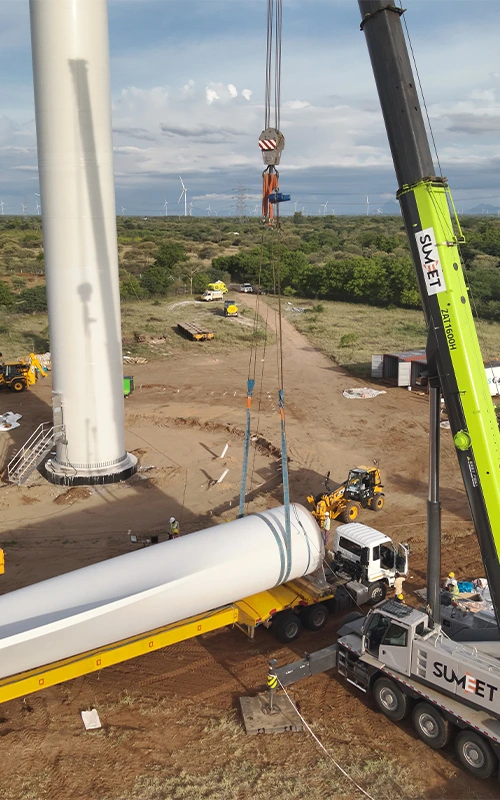
The Real Cost of Poor Site Visibility
Schedule Slippage
Undetected construction delays cascade across turbine delivery and commissioning windows, triggering liquidated damages.
No Real-Time Visibility
Monthly site visits miss weeks of deviation. By the time you know, recovery costs are significantly higher.
Disputes Without Proof
Without time-stamped visual evidence, contractor accountability disputes are impossible to resolve objectively.
Cost Overruns
Poor coordination between sub-contractors and owner’s engineers leads to rework, resource waste, and budget erosion.
L2 Schedule Misalignment
Without actual-vs-planned tracking, your L2 Gantt chart becomes a fiction document rather than a management tool.
Disputes & Documentation Risk
Billing disputes and contractor performance disagreements are almost impossible to resolve without time-stamped.
Service Overview
Our Wind Farm Project Monitoring Services — Built for EPC Complexity
Wind farm construction is non-linear, geographically dispersed, and multi-contractor by nature. A single missed milestone — a delayed access road, a tower foundation setback — can push back an entire WTG string. Traditional monitoring methods: periodic site visits, contractor self-reporting, and spreadsheet-based tracking, were not designed for this environment.
Our wind farm project monitoring services integrate aerial data capture, structured visual reporting, and schedule analytics into a unified framework aligned with your L2 project schedule. Teams across India use Lesoko to stay in control of active construction sites they cannot visit every week.
- Periodic drone flights: daily, weekly, or milestone-triggered
- Georeferenced orthomosaic maps and 4K video walkthroughs
- Structured milestone completion reports per WTG location
- Actual vs. Planned progress mapped against your L2 Gantt
- Time-stamped evidence for contractor accountability
- Consolidated multi-site dashboards for project leadership
- Deliverables in KML/GIS layers, PDF reports, and video
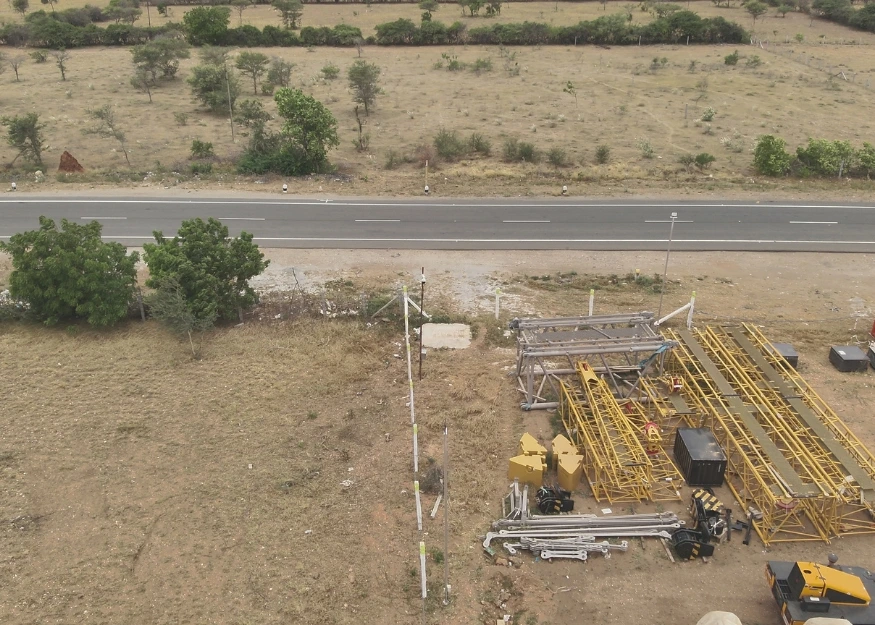
Core Monitoring Solutions
Four Critical Monitoring Layers for Wind Farm Construction
Each phase of wind farm construction introduces distinct monitoring requirements. Lesoko structures its service around four interlocking layers — giving every project stakeholder the data they need, when they need it.
✦ Access Road & Site Infrastructure Monitoring
Access roads, drainage structures, and WTG platform preparation form the critical path for equipment mobilization. Any delay here directly impacts turbine delivery schedules.
- Road alignment & grading
- Platform leveling
- Drainage structures
- Cable trench routes
- Soil compaction zones
Drone data enables precise earthwork volume estimation and surface condition analysis — far beyond what visual inspection can provide.
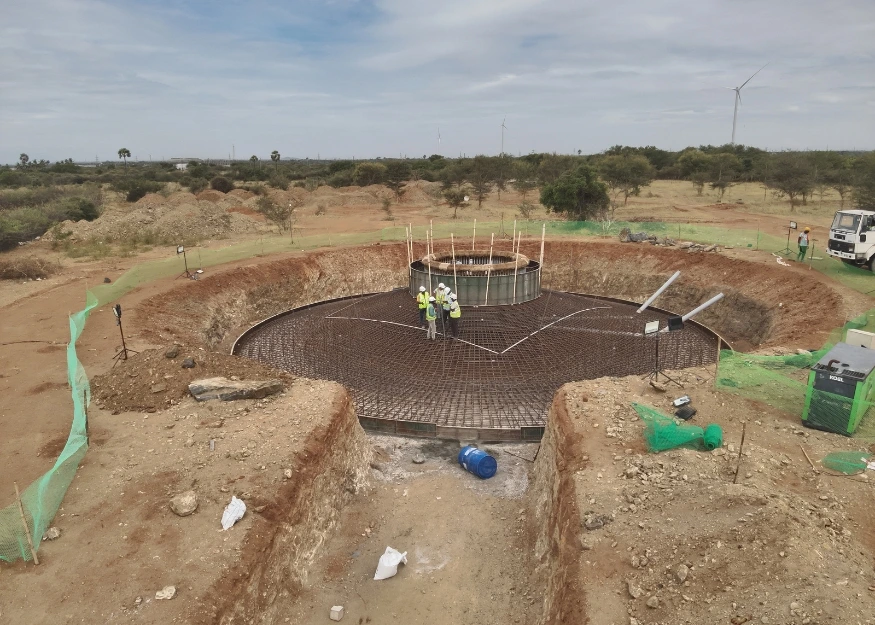
✦ Construction Milestone Tracking
Every WTG location has a defined sequence: site prep → foundation excavation → reinforcement → concreting → curing. Slippage at any point delays the string commissioning date.
- Excavation progress
- RCC status
- Curing timeline
- Backfilling
- Milestone certification readiness
Visual proof of milestone completion supports payment certification and resolves contractor disputes before they escalate.
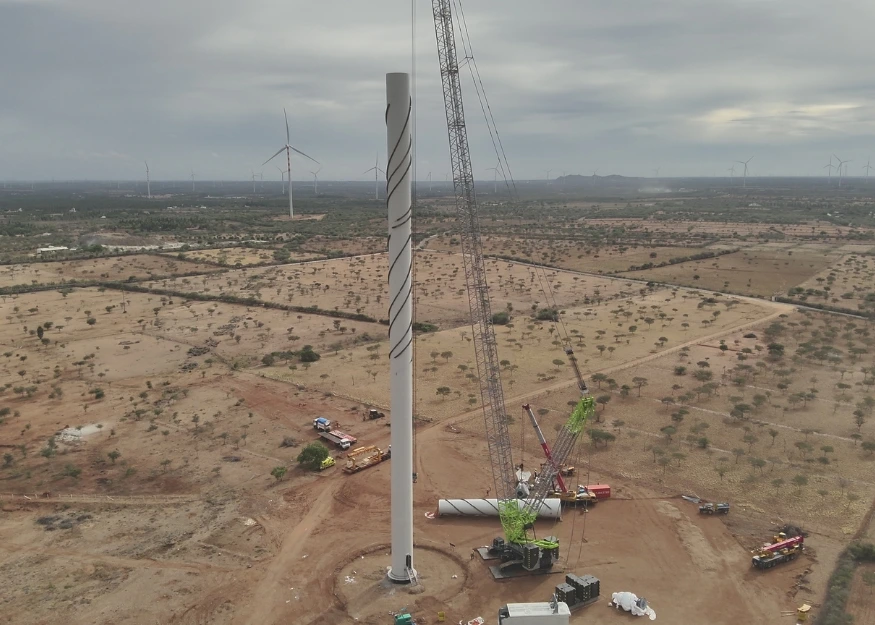
✦ Foundation & Tower Erection Monitoring
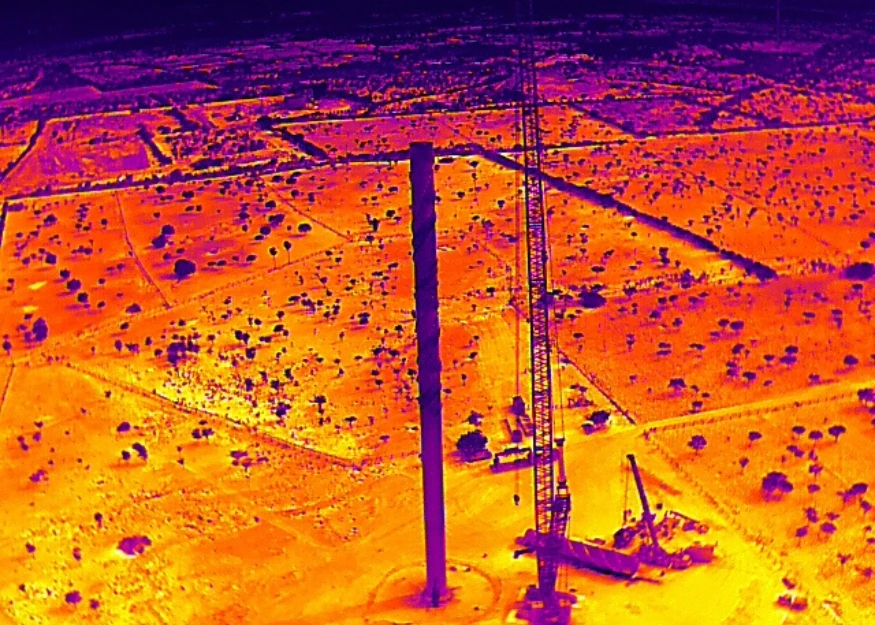
Tower section delivery, lay-down area management, and erection sequence tracking are resource-intensive and schedule-sensitive. Uncoordinated logistics cause costly idle time for cranes and crews.
- Section delivery staging
- Crane positioning
- Bolt-up completion
- Tower verticality
- Lay-down yard occupancy
Aerial overviews of multi-WTG erection progress give project managers a real operational picture across the entire wind farm layout.
✦ Turbine Installation Progress Mapping
Nacelle lifts, blade installation, and pre-commissioning checks represent the highest-value milestones in the project lifecycle. Any delay during this phase directly impacts COD commitments and revenue generation.
- Nacelle installation status
- Blade installation
- Hub assembly
- Pre-comm readiness
- WTG string completion %
Completion mapping across all WTG locations gives asset owners and lenders an auditable record of installation progress and commissioning readiness.
L2 Schedule Tracking & Progress Analytics
Actual vs. Planned — Know Where You Stand, Always
The L2 schedule is the contractual backbone of every wind project. Without actual progress data mapped against it, it is nothing more than a planning artifact. Lesoko provides the field data that makes your L2 schedule a live management tool.
Sample WTG String Progress
What L2-Aligned Monitoring Delivers
When tower erection slips three weeks behind plan, your project team needs to know immediately not during the next monthly review. Our wind farm project monitoring services are calibrated to give you actionable visibility within the decision-making window that can still make a difference.
- Delay detection lead time
- Reporting frequency
- Coverage per flight
- Evidence format
- Schedule mapping
- 2–4 weeks earlier
- Weekly or fortnightly
- Full site, all WTGs
- Time-stamped + GPS-tagged
- Actual vs Planned overlays
Why Drone Monitoring is Superior
The Monitoring Gap: Traditional Methods vs. Lesoko
Most wind projects still rely on contractor-reported progress, periodic site visits, or in-house EPC tracking teams. Each approach carries structural blind spots that drone-based monitoring eliminates.
| Capability | Traditional / Manual | Lesoko Drone Monitoring |
|---|---|---|
| Site coverage per visit | Spot checks / sampling only | 100% site coverage per flight |
| Real-time visual evidence | Not available | 4K drone video + orthomosaic |
| L2 schedule integration | Manual / subjective estimate | Actual vs Planned comparison |
| Dispute documentation | No timestamped proof | GPS + time-stamped records |
| Multi-site tracking | Not scalable | Consolidated multi-site reports |
| Remote accessibility | Physical presence required | Reports delivered digitally |
| Data formats | Word / Excel reports only | PDF, GIS, KML, video, DEM |
Drone Monitoring in Action — Real Projects Across India
Every image below is captured from an actual Lesoko drone flight. This is what your project reports look like.
Real-World Use Cases · India
How Indian Wind Project Teams Use Lesoko
📍Tamil Nadu · 100 MW Wind Farm
Multi-Contractor EPC Coordination
A developer managing four sub-contractors across 40 WTG locations used fortnightly Lesoko drone reports to independently verify milestone completion claims before releasing contractor payments eliminating disputed invoices worth ₹2.8 Cr.
📍Gujarat · 150 MW IPP Project
Remote Site Visibility for Lender Reporting
An IPP with project financing requirements used Lesoko's monthly visual progress reports to fulfill lender monitoring obligations providing the independent construction progress evidence required for drawdown certifications.
📍 Rajasthan · 80 MW Hybrid Project
Dispute Resolution via Time-Stamped Documentation
During a contractual dispute over foundation completion timelines, the Owner's Engineer used Lesoko's georeferenced drone records as objective evidence resolving a potential arbitration in 18 days rather than months.
📍 Karnataka · 60 MW Repowering
L2 Schedule Recovery Monitoring
An EPC contractor behind schedule used our weekly wind farm project monitoring services to demonstrate recovery progress to the developer and avoid LD penalties each weekly report serving as a formal progress certification update.
Benefits & ROI
What Structured Monitoring Protects
For a 100 MW wind project, a 30-day commissioning delay can represent ₹4–7 Cr in lost generation revenue alone — before accounting for liquidated damages. The cost of monitoring is a fraction of the risk it mitigates.
4× Faster Delay Detection
Identify schedule deviations weeks before they become unrecoverable, preserving your critical path.
↓LD Reduced Liquidated Damages Exposure
Early visibility enables recovery planning that keeps commissioning dates achievable.
0 Dispute-Proof Documentation
Time-stamped, GPS-tagged records eliminate ambiguity in contractor accountability discussions.
100% Site Coverage Every Cycle
No sampling, no blind spots — every WTG location covered on every monitoring cycle.
72hr Structured Report Delivery
Detailed visual reports in PDF, GIS layers, and video delivered within 72 hours of each flight.
Why Choose Lesoko
India's Trusted Provider of Wind Farm Project Monitoring Services
DGCA-Compliant Operations
All flights conducted under DGCA regulations with certified remote pilots and proper airspace clearances — essential for insurance, lender, and regulatory compliance on wind projects.
PAN-India Deployment Capability
From Thoothukudi to Jaisalmer, our wind farm project monitoring services teams operate across India's key wind corridors with local logistics and no mobilization delays.
Renewable Energy Domain Expertise
We understand L2 schedules, EPC contract structures, WTG string sequencing, and the commissioning pressures unique to wind energy projects in India.
Structured, Stakeholder-Ready Reporting
Our reports are designed for project managers, owner's engineers, and lenders structured for decision-making, not just data delivery.
The Expert Perspective
In wind project execution, visibility is not a nice-to-have — it is a risk management instrument. The window between a detectable delay and an unrecoverable one is often 3–4 weeks. By the time a monthly site visit reveals the problem, the recovery cost has multiplied.
Lesoko's approach treats drone data as a primary project management input not supplementary documentation. Every report is structured to answer the question that matters: Are we on track, and if not, what does recovery require?
For assets under construction finance, visual progress evidence is also a lender requirement. Our reports are formatted to meet independent engineer and monitoring engineer standards.
Why Wind Project Monitoring Requires Specialist Knowledge
Industry Insight
Turbine Commissioning Impact
Milestone Tracking in Wind Projects
Visual Documentation in Arbitration
EPC–Developer Coordination Gaps
Watch How Lesoko Monitors a Wind Farm Construction Site
From site access roads to turbine erection — this is what real wind farm progress tracking looks like on the ground. Watch how our pilots capture weekly orthomosaics and georeferenced imagery across your entire project area, without delaying a single contractor activity. Every image feeds directly into your Actual vs Planned L2 progress report.
Take Control of Your Project Timeline Before It Slips
Phone/ Whatsapp
+91 78457 26375/ 7845726374
Email Us
sales@lesoko.in