
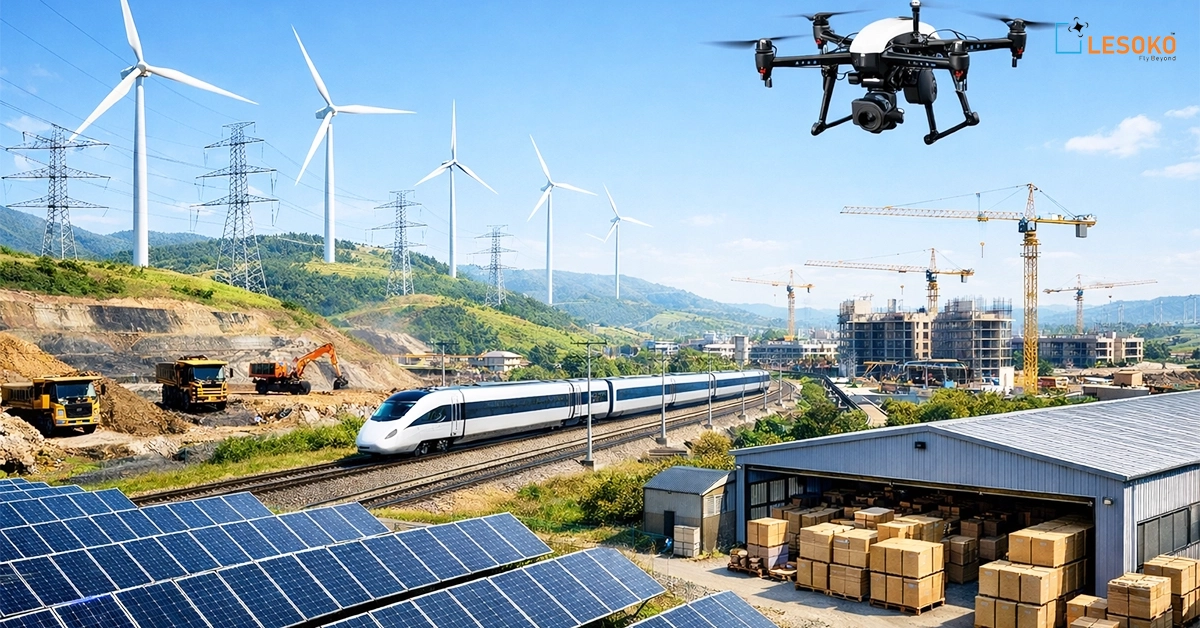
Drone as a Service (DaaS) in India | Aerial Intelligence Solutions — Lesoko
Drone as a Service (DaaS) in India: The Complete Guide to Aerial Intelligence for Energy, Mining & Infrastructure
India is building at a scale that has no modern precedent. Solar parks spanning thousands of acres. High-voltage transmission corridors crossing states. Mines pushing deeper every quarter. Smart cities reshaping how people live, work, and move. Every one of these projects runs on one critical input: accurate site data, delivered fast.
Traditional methods — manual surveys, rope-access inspections, and field sketches — cannot keep up. They are too slow, too expensive, and too dangerous. That is precisely why Drone as a Service (DaaS) in India is growing at over 25% CAGR, and why project owners across renewable energy, mining, infrastructure, and railways are replacing guesswork with on-demand aerial intelligence.
Lesoko Technologies is a full-stack drone as a service company in India headquartered in Chennai. With over 2,00,000 safe flights completed, 13,000+ rooftop surveys delivered, 6+ GW of solar assets inspected, and ₹53 million saved in client operational costs, Lesoko provides end-to-end drone services — from precision aerial data capture to AI-powered analytics and reporting — across every major industrial sector in India.
This guide covers everything a project owner, EPC contractor, asset manager, or operations head needs to know about Drone as a Service (DaaS) in India: what it is, how it works, which industries are using it, what Lesoko delivers, and how to get started.
What Is Drone as a Service (DaaS)?
Drone as a Service (DaaS) is a delivery model in which organisations access professional drone operations, data collection, analytics, and reporting on a project-by-project, subscription, or pay-per-use basis — without purchasing drones, hiring pilots, or managing data infrastructure themselves.
Rather than investing capital in hardware, training, DGCA certification, and data processing tools, clients contract a specialist provider like Lesoko to capture the aerial data they need and deliver it as a finished, actionable report. The client pays for the outcome — accurate survey data, a thermal inspection report, a 3D model, volumetric analysis — not for the equipment that produced it.
Think of it like cloud computing, but for aerial intelligence. The drones, the pilots, the software, the compliance, and the processing are all handled by Lesoko. You receive the insights.
DaaS vs. Owning Drones — A Direct Comparison
| Owning Drones | DaaS with Lesoko |
| High upfront capital cost | Zero hardware investment — pay per project or contract |
| Pilot recruitment, training & DGCA certification | DGCA-certified pilots on every flight, included |
| Hardware maintenance and rapid obsolescence | Always latest drone technology, maintained by Lesoko |
| In-house data processing expertise required | AI analytics, processing, and reports delivered to you |
| Full regulatory compliance burden on your team | All DGCA compliance and flight permissions handled |
| Days to mobilise at a new project site | On-site within 24–48 hours anywhere in India |
| Safety liability on every manual rooftop visit | Zero worker roof access — drone replaces every visit |
Why Drone as a Service Is Growing Fast in India
The growth of drone as a service in India is not driven by hype. It is driven by the scale of India’s infrastructure ambitions colliding with the limitations of traditional survey and inspection methods.
National Infrastructure Scale Demands Aerial Efficiency
India is targeting 500 GW of renewable energy by 2030. Every solar park, wind farm, transmission corridor, and mining site requires precise topographic surveys, structural inspections, and ongoing progress monitoring — at a volume and speed that ground crews cannot deliver. Drone services are the only method that scales with India’s project pipeline.
DGCA Regulatory Reform Has Made Drone Operations Mainstream
India’s Drone Rules 2021 significantly simplified the regulatory framework. The Digital Sky Platform streamlined flight permissions. Government programmes — including the PM-Kisan Drone Yojana and the SVAMITVA land-mapping scheme — are actively funding drone data collection at a national level. Compliance is clearer, and operators like Lesoko with DGCA-certified pilots can mobilise faster than ever.
Cost and Safety Pressure Are Forcing the Shift
Manual site surveys mean multiple days on-site, workers on fragile or high-risk rooftops, and rope-access inspections on live transmission towers. Each of these methods carries real HSE liability. Drone as a service eliminates physical access entirely — the same data is captured in a fraction of the time, with no worker exposure to height, heat, or structural risk.
Market Growth Trajectory
Industry data from FICCI-EY and the Ministry of Civil Aviation projects the Indian drone services market growing at 18–25% CAGR through 2030. Services — not hardware — represent the largest and fastest-growing segment of that market. Businesses want results, not drones.
Lesoko’s Proven Track Record in Drone as a Service
Lesoko is not a startup experimenting with drone technology. It is a national-scale drone as a service company in India with a proven delivery record across India’s most demanding energy and infrastructure projects.
| 2,00,000+ Safe Drone Flights | 13,000+ Rooftop Surveys | 6+ GW Solar Assets Inspected | 3,000 km Transmission Lines Surveyed | 1 cm RTK-GPS Accuracy | ₹53M+ Client Cost Savings |
These are live operational figures — not projections. Lesoko’s drone teams are deployed across Rajasthan, Gujarat, Tamil Nadu, Maharashtra, Karnataka, Telangana, Andhra Pradesh, and every major solar and infrastructure corridor in India.
Lesoko’s Core Drone as a Service (DaaS) Portfolio
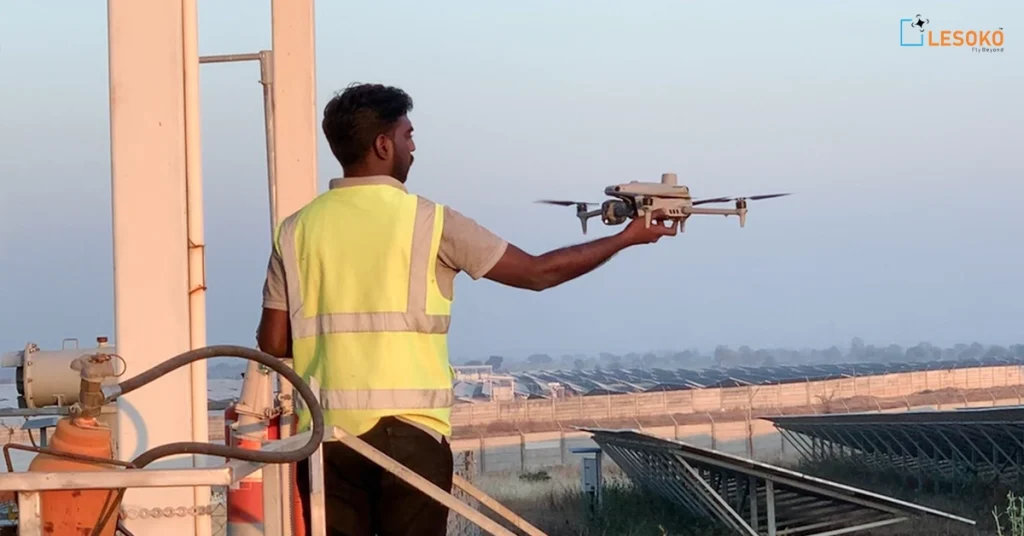
Lesoko’s drone as a service portfolio covers six core service lines, each built to address the full asset lifecycle — from pre-construction surveys to operational inspections and ongoing monitoring.
1. Precision Topographic & LiDAR Surveys
Using RTK-GPS, DGPS, and LiDAR-equipped drones, Lesoko delivers centimetre-level terrain intelligence — the foundational data layer for every infrastructure and energy project. Drone LiDAR surveys are 70x faster than conventional ground-based methods and achieve sub-centimetre positional accuracy without any physical access to the terrain.
Deliverables: Digital Surface Models (DSM), Digital Terrain Models (DTM), contour maps, slope and clearance analysis, and geo-referenced corridor mapping — all compatible with AutoCAD, Civil 3D, ArcGIS, and QGIS.
Best for: Solar farm pre-construction planning, transmission corridor routing, mining site baseline surveys, road and rail pre-construction mapping, smart city GIS.
2. Aerial Thermal & Visual Inspection
Lesoko’s aerial thermal and visual inspection service uses AI-driven thermal cameras and high-resolution RGB imaging to identify defects, faults, and structural issues that are invisible to the human eye — and undetectable by SCADA or manual walkthroughs.
Thermal inspections detect temperature anomalies caused by hotspots, diode failures, insulation breakdown, and structural stress. RGB inspections capture soiling patterns, physical damage, misalignment, corrosion, and surface degradation — producing a comprehensive fault map for every asset inspected.
Best for: Solar panel hotspot detection, wind turbine blade condition assessment, transmission tower component audits, railway OHE thermal surveys, industrial structure inspections.
3. Volumetric & Stockpile Analysis
Drone-based volumetric analysis gives mining operators, quarry managers, and construction companies precise stockpile volumes, cut-and-fill calculations, and excavation progress data — without sending workers into hazardous zones.
Using photogrammetry and LiDAR, Lesoko’s surveys measure dump heights, slope stability, haul road geometry, and stockpile volumes to within 1% of actual measurement — significantly more accurate than traditional surveyor-with-theodolite methods, and completed in a fraction of the time.
Deliverables: 3D volumetric models, progress reports, slope stability maps, haul optimisation data — all accessible via the Lesoko cloud dashboard.
4. Infrastructure Monitoring & Asset Mapping
For project owners and asset managers responsible for linear or complex infrastructure, Lesoko provides continuous aerial monitoring that replaces dangerous manual inspections with safe, scheduled drone missions.
Asset mapping deliverables include digital twin models, component-level asset catalogues, vegetation encroachment analysis, and condition reports — all geo-referenced and accessible via the Lesoko client dashboard. Construction monitoring deliverables include block-by-block progress reports, deviation detection, and subcontractor audit data that gives project managers remote visibility without a site visit.
Best for: Power line corridor monitoring, metro and rail viaduct assessments, highway construction tracking, pipeline integrity mapping, civil structure surveys.
5. 24/7 Drone Surveillance & Security
High-value remote assets — solar parks, industrial facilities, mining sites — face persistent security risks including unauthorised access, equipment theft, and wildlife intrusion. Lesoko’s 24/7 drone surveillance service uses night-vision cameras, thermal sensors, and real-time monitoring to patrol large sites continuously.
The system detects and flags anomalies — perimeter breaches, suspicious movement, fire signatures, and structural changes — and delivers automated alerts to site security teams. Response times are faster, asset losses are lower, and unlike manned security, aerial surveillance covers every corner of a site simultaneously.
6. AI-Powered Data Analytics & Reporting
Raw aerial data has no value until it drives decisions. Every Lesoko drone as a service engagement includes AI-powered data processing that converts captured imagery and sensor data into structured, actionable outputs.
Lesoko’s cloud-based analytics platform delivers defect detection reports, progress dashboards, yield modelling, ROI tracking, and stakeholder-specific KPI reports — all via a secure, role-based client dashboard accessible from any device, anywhere. Data is stored with ISO-compliant security protocols; your site data is never shared.
Industry Applications of Drone as a Service in India
Lesoko’s industrial drone services are active across India’s highest-growth sectors. Every application below is a live, operational service — not a future capability.
Solar Energy — Survey, Inspection & O&M
Drone as a service for solar energy covers the complete project lifecycle, from the first feasibility survey to operational O&M inspections years after commissioning.
Solar Rooftop Survey
Lesoko’s drone solar rooftop survey uses RTK-GPS drones to capture sub-centimetre accurate 2D and 3D rooftop models, orthomosaic maps, shadow and shading analysis, digital elevation models, and SketchUp/AutoCAD-ready design files — all delivered within 48 hours of the site visit.
Wrong rooftop measurements cause incorrect panel counts, mounting mismatches, and cable routing errors that are only discovered on installation day — after panels, mounts, and hardware have already been ordered. The drone rooftop survey eliminates every one of these errors before a single panel leaves the warehouse. Lesoko has completed 13,000+ rooftop surveys across India, trusted by Tata Power, L&T, ReNew Power, and 50+ solar EPCs.
Ground-Mount Solar Survey
Large ground-mounted solar parks require detailed topographic data before a single pile is driven. Lesoko’s drone ground-mount survey uses LiDAR and RTK-GPS to map land contours, slopes, gradients, and drainage patterns across parcels of any size — enabling panel placement optimisation, earthwork cost reduction, and drainage planning that prevents long-term generation losses.
Solar Panel Thermal Inspection
Operational solar plants lose 15–30% of their generation capacity to faults that SCADA systems never flag. Lesoko’s drone solar panel inspection uses thermal cameras to detect hotspots, broken bypass diodes, and defective modules at the cell level — across an entire utility-scale plant in a single flight session.
High-resolution RGB imaging runs simultaneously, identifying soiling patterns, physical damage, incorrect alignment, and connector corrosion. The combined thermal and visual inspection report gives O&M teams a prioritised fault list that maximises the impact of every maintenance visit.
Solar Project Construction Monitoring
Drone-enabled solar construction progress monitoring tracks block-by-block installation status, module deployment, inverter room progress, trench work, and cable laying — using geotagged aerial imagery and AI-based deviation detection. Project managers get remote visibility into daily site activity without travel, and clients receive transparent progress reports that reduce disputes with subcontractors.
Night Surveillance for Solar Plants
Remote solar parks face after-hours security threats that manned guards cannot cover cost-effectively. Lesoko’s drone night surveillance patrols plant perimeters using thermal sensors and night-vision cameras, flagging unauthorised entry, wildlife intrusion, and equipment tampering in real time. Automated alert dispatch reduces response time and asset losses across installations of any size.
Mining — Survey, Mapping & Compliance
Lesoko’s drone mining survey services deliver the spatial intelligence that mine planners, operations heads, and compliance teams need — without sending surveyors into active extraction zones.
Mining Topographic Survey & Mapping
Drone-based topographic surveys of mine sites produce accurate 3D terrain models, digital mine models, settlement maps, and infrastructure position data. These survey outputs support pit design, extraction strategy optimisation, and MCDR regulatory compliance — replacing multi-day manual surveys with a single drone flight and a 48-hour processed report.
Stockpile Volume & Excavation Monitoring
Lesoko measures stockpile volumes, dump heights, and slope geometry with photogrammetry accuracy to within 1% of physical measurement. Haul road optimisation, blasting zone safety surveillance, and subsidence monitoring are all supported by regular drone surveys that keep mine management current on site conditions — with zero personnel exposure to hazardous zones.
Infrastructure — Roads, Railways, Metro & Civil Projects
Drone infrastructure survey and monitoring services from Lesoko cover the full lifecycle of road, rail, metro, and civil construction — from pre-construction topographic baseline surveys through construction monitoring to operational asset inspection.
Infrastructure Survey, Mapping & Planning
Pre-construction drone surveys provide topographic maps, land-use analysis, tree-count data, corridor mapping, encroachment detection, and cadastral overlay data — replacing field survey teams with a single flight that covers hundreds of hectares in one session. GIS-ready deliverables support smart city planning, site selection, environmental impact assessments, and route feasibility studies.
Infrastructure Project Monitoring & Management
Drone-powered construction monitoring tracks project progress against schedule and SOP benchmarks — identifying deviations, hazards, and quality issues before they become delays. High-resolution aerial imagery and AI-based analytics give project owners and clients accurate, impartial progress data that improves coordination and reduces cost overruns across complex multi-site projects.
Power Transmission — Survey, Inspection & LiDAR
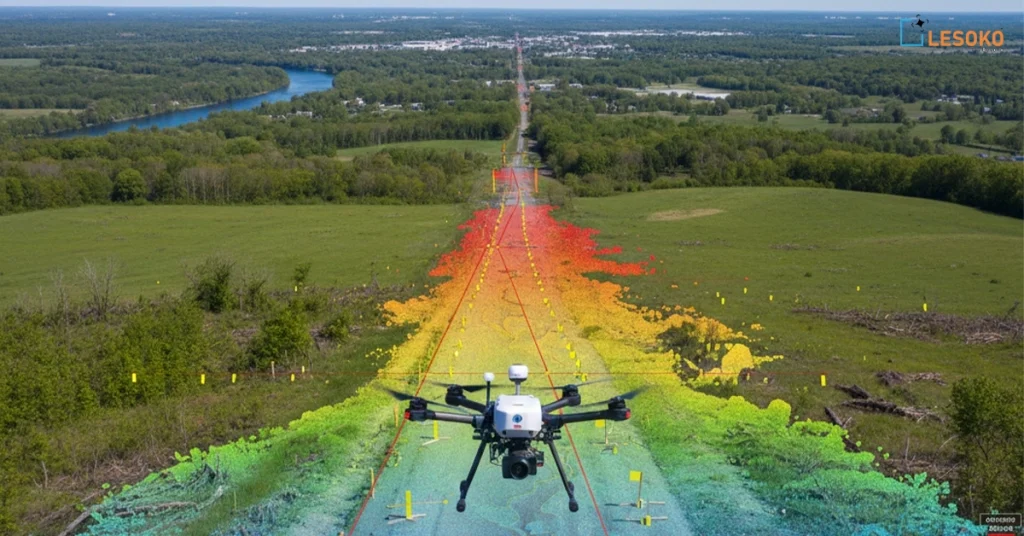
Lesoko has surveyed and inspected over 3,000 km of transmission infrastructure across India. Drone transmission line services eliminate the need for tower-climbing inspections, reduce line outages during inspection windows, and deliver data accuracy that manual methods cannot match.
Transmission Tower & Line Inspection
Drone transmission tower inspection provides comprehensive assessment of tower components, crossarms, insulators, conductor attachments, switchyard equipment, and substation structures — using both high-resolution RGB imaging and thermal cameras. Vegetation encroachment analysis identifies clearance violations before they cause outages. Lesoko’s inspection reports give maintenance teams a prioritised fault list that drives proactive intervention rather than reactive repair.
Transmission Route Alignment Survey
For new transmission line construction, drone-based route alignment surveys use topographic mapping to identify the optimal corridor — factoring in terrain, encroachments, land use, and environmental sensitivity. Accurate aerial data reduces land acquisition disputes, accelerates government approval processes, and minimises the environmental footprint of new line corridors.
Transmission LiDAR Survey
Drone LiDAR surveys for transmission lines provide highly precise phase-to-phase, phase-to-ground, and ground clearance measurements — including in areas with dense vegetation where photogrammetry alone cannot penetrate to the ground surface. LiDAR data identifies sag risks, regulatory clearance violations, and conductor condition issues that are essential for safe, compliant power transmission planning.
Transmission Project Construction Monitoring
Drone monitoring of transmission line construction tracks foundation work, tower erection, stringing progress, and access road development — providing clients and EPC contractors with real-time aerial visibility into every section of a multi-hundred-kilometre project. Progress reports reduce delays, improve coordination between crews, and ensure project delivery against contracted milestones.
Wind Energy — Blade Inspection, Survey & Project Monitoring
Wind Turbine Blade Inspection
Drone wind turbine blade inspection identifies erosion, surface cracks, lightning strike damage, leading-edge pitting, and trailing-edge delamination — faults that are invisible from the ground and require turbine shutdown and rope access to inspect manually. Drone inspections eliminate both the shutdown time and the rope-access risk, delivering close-up imagery of all blade surfaces within a single turbine session.
Early defect detection prevents small blade surface damage from progressing to structural failure, extending blade life and supporting the predictive maintenance schedules that protect turbine performance over a 20-year operational lifespan.
Wind Site Survey & Planning
Drone-enabled wind surveys assess terrain conditions, access route viability, land use constraints, and environmental impact factors across potential wind farm sites. Topographic and zoning assessments support turbine placement optimisation, infrastructure planning, and regulatory compliance — reducing the risk and cost of pre-development site assessment.
Wind Project Construction Monitoring
Drone wind project monitoring tracks construction milestones including foundation work, tower erection, nacelle installation, and blade fitting — providing project stakeholders with accurate progress data and early warning of schedule deviations. Aerial visuals improve coordination between civil, mechanical, and electrical crews working simultaneously across large, remote wind farm sites.
Railways & Metro — Corridor Survey & OHE Inspection
Drone railway inspection and survey services from Lesoko support Indian Railways, metro rail projects, and private rail operators with corridor mapping, OHE and catenary line inspection, structural assessment, and construction monitoring.
High-resolution drone imagery detects structural flaws, alignment deviations, component wear, and foreign object fouling across OHE systems — without interfering with live train operations. Corridor surveys deliver accurate topographic data for new route planning, track geometry analysis, and vegetation encroachment monitoring.
For metro construction projects, drone monitoring provides daily visibility into viaduct progress, station construction, and track installation — enabling project managers to identify and resolve delays before they cascade across the programme.
Why Choose Lesoko for Drone as a Service in India
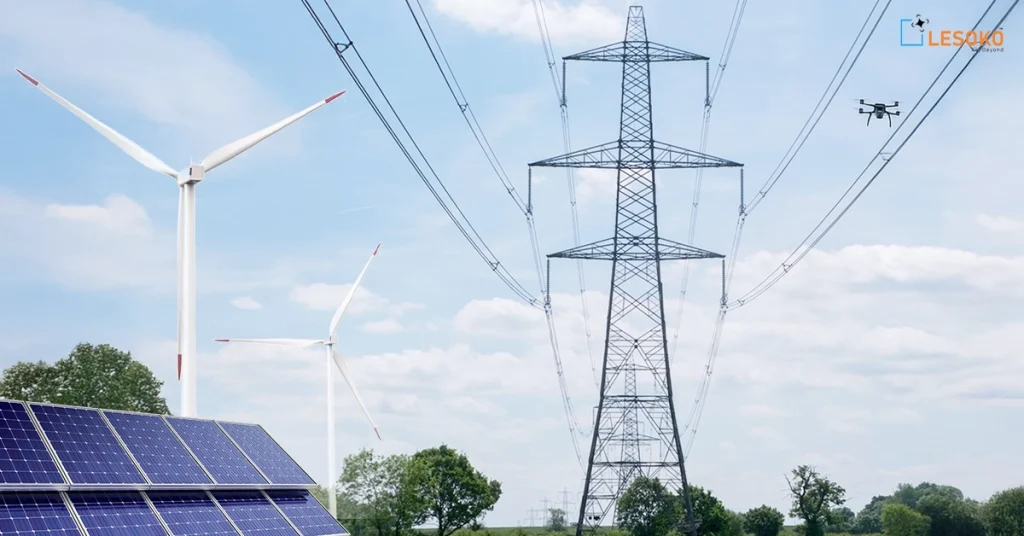
India has multiple drone service providers. What separates Lesoko is not a capability claim on a brochure — it is a decade of execution across India’s most complex energy and infrastructure projects.
| Advantage | What It Means For Your Project |
| DGCA-Certified Pilots | Full regulatory compliance on every flight, nationwide. No legal exposure, no permit surprises, no airspace issues. |
| Sub-Centimetre RTK Accuracy | 1 cm positional accuracy on every survey. Design rework, post-installation corrections, and costly on-site surprises are eliminated before they occur. |
| 48-Hour Report Delivery | Complete processed deliverables — 2D/3D models, thermal reports, analytics — within 48 hours of the site visit. Respond to client RFQs before competitors have finished scheduling their manual survey. |
| Pan-India Deployment | Certified teams deployed within 24–48 hours across all major solar, mining, infrastructure, and transmission corridors in India. |
| AI-Powered Analytics Platform | Every engagement delivers not just data but decisions. AI-processed defect maps, yield models, and progress dashboards are delivered to your secure client dashboard. |
| Secure Cloud Dashboard | All survey data, models, and reports are accessible via role-based login from any device, anywhere. ISO-compliant data security. Your site data is never shared. |
| Proven at National Scale | 2,00,000+ safe flights. 6+ GW solar inspected. 13,000+ rooftop surveys. 3,000+ km transmission lines surveyed. This is not experimentation — it is national-scale execution. |
Trusted by India’s Largest Energy and Infrastructure Companies
- Tata Power · L&T (Larsen & Toubro) · ReNew Power · Adani Group
- Indian Railways · Coal India · Reliance
- SECI · WBREDA · BREDA · MEDA · TNEB
- Freyr Energy · TEQO · 50+ solar EPCs and IPPs across India
Frequently Asked Questions — Drone as a Service (DaaS) in India
What is Drone as a Service (DaaS)?
Drone as a Service (DaaS) is a delivery model where organisations access professional drone operations, data collection, and analytics on a project or subscription basis — without owning or operating drones. Clients pay for outcomes such as survey reports, thermal inspections, 3D models, or volumetric analysis, delivered by a DGCA-certified provider like Lesoko.
How does Drone as a Service work in India?
A client specifies the project scope — rooftop survey, solar panel inspection, mining stockpile measurement, or transmission line inspection. Lesoko handles DGCA compliance, flight planning, data capture, processing, and report delivery. Clients receive finished, actionable deliverables — typically within 48 hours of the site visit — via a secure cloud dashboard.
Why is DaaS better than buying and operating drones yourself?
Owning drones requires capital expenditure on hardware, pilot recruitment, DGCA certification, maintenance, and data processing software. DaaS eliminates all of these costs. You pay only for outcomes, always access the latest drone technology, and receive deliverables from domain experts. For EPCs, IPPs, and asset managers, DaaS consistently delivers better ROI than in-house drone operations.
What industries use Drone as a Service in India?
DaaS is actively deployed across solar energy (rooftop surveys, panel inspections, O&M), mining (stockpile volumetrics, topographic mapping, compliance surveys), power transmission (tower inspections, LiDAR surveys), railways and metro (OHE inspection, corridor mapping), wind energy (blade inspection), infrastructure (road, metro, and civil project monitoring), and government programmes including SVAMITVA and smart city GIS.
Are Lesoko’s drone services DGCA certified?
Yes. All Lesoko drone operations are flown by DGCA-certified remote pilots using DGCA-type-certificated drone platforms. Lesoko manages all flight permissions, airspace authorisations, and regulatory compliance on every project. Clients do not need to manage any drone paperwork.
How accurate is a Lesoko drone survey?
Lesoko achieves sub-centimetre positional accuracy — typically better than 1 cm horizontally — using RTK-GPS technology. This precision eliminates the measurement errors that cause design rework, mounting mismatches, and installation corrections on solar, mining, and infrastructure projects.
What is the cost of drone as a service in India?
DaaS pricing depends on project type, site area, location, and required deliverables. Small rooftop surveys, utility-scale thermal inspections, and annual multi-site contracts are each priced differently. Contact Lesoko for a project-specific quote within 24 hours — most engagements cost significantly less than the rework, downtime, or safety incidents they prevent.
How quickly can Lesoko mobilise a drone survey team?
Lesoko’s DGCA-certified teams are available for deployment within 24–48 hours across all major project corridors in India. Processed deliverables — 2D/3D models, thermal reports, volumetric analysis — are ready within 48 hours of the site visit.
Ready to Put Drone as a Service (DaaS) to Work on Your Projects?
Drone as a Service (DaaS) in India has moved from a competitive advantage to a baseline operational requirement. Every week that project owners run manual surveys, send workers onto live structures, or wait for slow-turnaround data is a week of margin lost to methods that drone services have already replaced at scale.
Lesoko Technologies delivers end-to-end drone as a service across solar energy, mining, power transmission, railways, wind energy, and infrastructure — with sub-centimetre accuracy, DGCA-certified operations, 48-hour report delivery, and a proven track record with India’s largest project owners.