
33kV Transmission Line Inspection: Tower-Level Thermal Severity Reports
106
Towers Inspected , Gondal
65%
Towers Needing Corrective Action
6 Days
Full Inspection Completed
5L+
Safe Drone Flights Zero Crashes
34+ GW
Solar Assets Inspected Across Client Base
The Operational Risk
Why Evacuation Line Faults Cost More Than You Expect
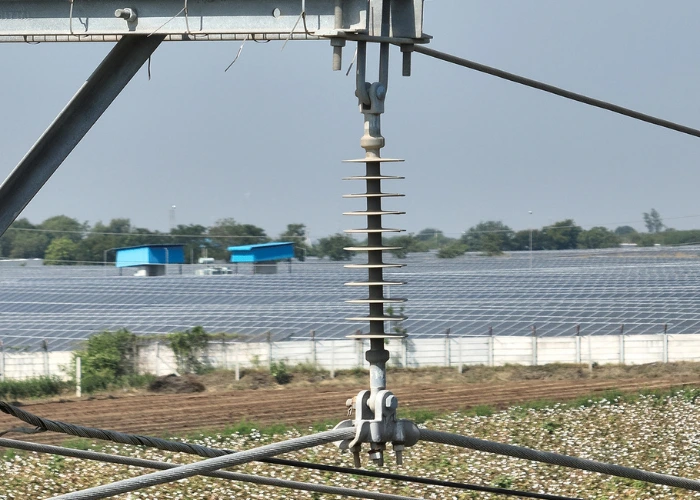
For a utility-scale solar IPP, the 33kV evacuation line is the single point of failure between generation and revenue. A forced outage on that line caused by an arc flash at an overheated jumper connection, an insulator flashover, or an earthing hardware failure does not merely interrupt generation. It activates PPA availability penalty clauses, initiates lender notification obligations, and triggers emergency corrective work at rates that compound daily. On a 10 MW plant, a single forced shutdown costs ₹3–6 lakh per day in lost generation revenue before maintenance costs are counted.
The compounding problem is that the faults most likely to cause these failures are the least visible. Thermal hotspots at bolted jumper connections develop gradually under resistive heating driven by connection oxidation, loose hardware, or conductor strand damage and reach arc flash threshold over weeks or months of load cycles. Reverse thermal variation across disc insulator strings is a pre-failure degradation signal that appears in the differential temperature profile of the insulator surface and is entirely invisible to ground patrol. By the time a physical defect is visible from below, the failure probability is already high.
The compliance dimension is now equally binding. Project finance lenders, equity investors, and insurance providers for utility-scale solar assets increasingly require third-party IE-grade transmission inspection documentation for refinancing reviews, insurance renewals, and PPA compliance assessments. The documentation standard has shifted from “last visited” to tower-indexed thermal data, severity-classified defect matrices, and geo-tagged photographic evidence. The output of a structured drone inspection programme, not a ground patrol cycle.
Service Definition
What Is 33kV Transmission Line Inspection?
A 33kV transmission line inspection is a structured, tower-level assessment of high-voltage evacuation infrastructure using drone-mounted visual and radiometric thermal imaging systems. The inspection covers every tower from the solar plant substation to the grid injection point insulators, jumper connections, conductor hardware, structural members, earthing connections, and bird guards producing a severity-classified, geo-tagged defect report for use in O&M planning, lender compliance, and independent engineering assessments. Findings are benchmarked against IS 5613 structural integrity criteria and IEC 60815 insulator pollution severity classifications, ensuring the output maps to recognised technical standards rather than proprietary observation checklists.
Drone-based inspection differs from conventional methods not merely in speed but in the nature of data it produces. A DJI Matrice 300 or 350 RTK platform equipped with a Zenmuse H20T payload captures 48MP visual imagery and radiometric thermal data simultaneously from multiple angles per tower on energised lines, at operational height, without personnel on structures. Simultaneous dual-payload capture is what enables the detection of reverse thermal variation in disc insulators and quantitative temperature differential analysis at jumper connections: capabilities requiring both thermal instrumentation and proximity to the energised component under load. Manual inspection teams, whether conducting ground patrols or scheduled tower climbs, structurally cannot produce these data sets the instrumentation and altitude access requirements are incompatible with ground-based methods. Under DGCA UAS Rules 2021, drone proximity operations near HT infrastructure require specific Remote Pilot Licences and corridor clearances that distinguish compliant industrial operators from general survey platforms.
4-Phase Methodology
How a 33kV Transmission Line Inspection Works
A structured, repeatable process delivering tower-level accountability for every component on your evacuation corridor.
Line Walk & Tower Indexing
Pre-inspection site survey to GPS-map every tower using RTK GPS for centimetre-level positioning accuracy. Each tower is assigned a sequential index number that anchors all subsequent defect records. DJI Terra is used for flight corridor planning and route optimisation around tower structures. Terrain constraints, vegetation clearance, and access limitations identified. DGCA UAS Rules 2021 corridor compliance and NOTAM requirements confirmed before any flight operation.
Drone Visual Inspection
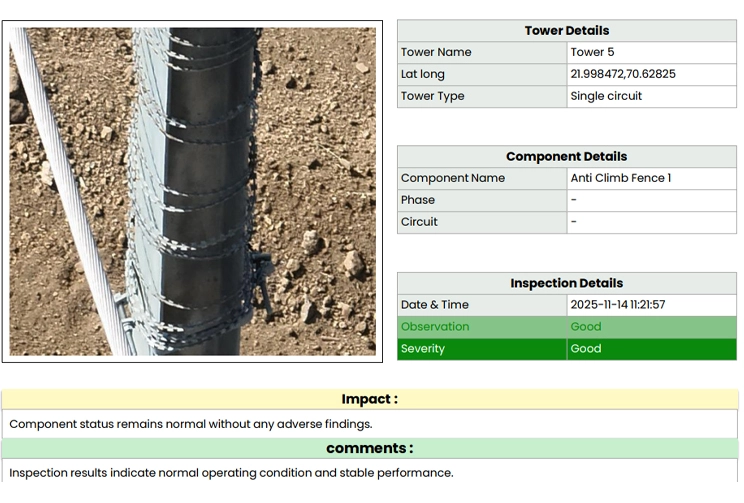
Each tower photographed from multiple approach angles using a 48MP RGB visual payload. Structural members, cross-arms, hardware fittings, suspension and strain insulator strings, jumper connections, earthing conductors, armour rods, vibration dampers, anti-climb devices, and bird guards assessed for physical condition cracking, corrosion, displacement, missing components, and visible mechanical damage. All imagery tower-indexed and geo-tagged at point of capture.
IR Thermography
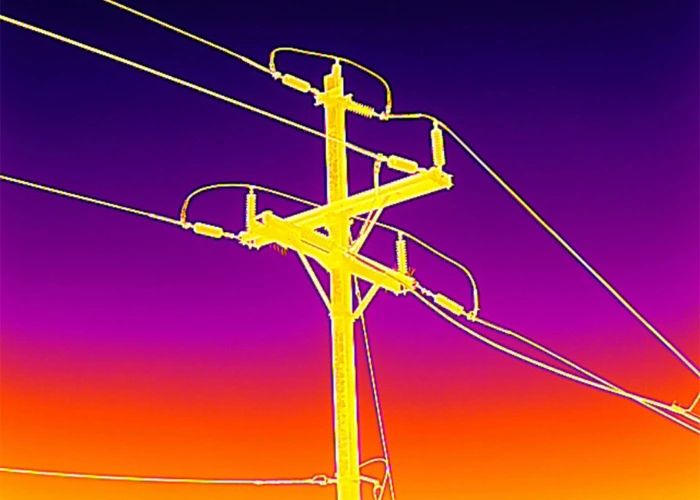
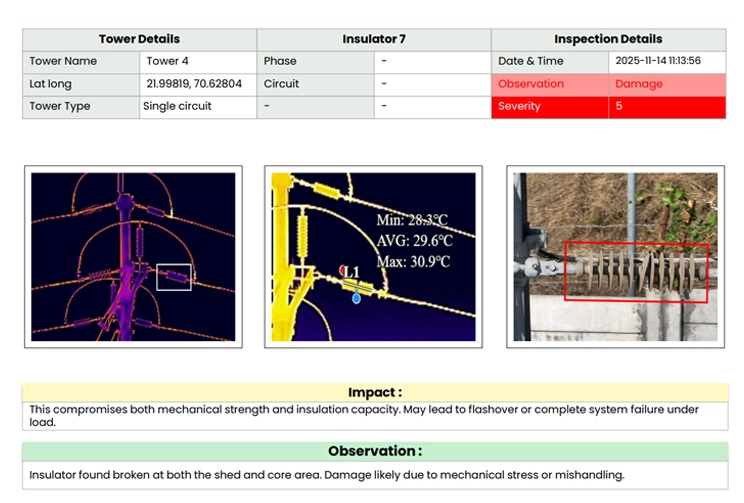
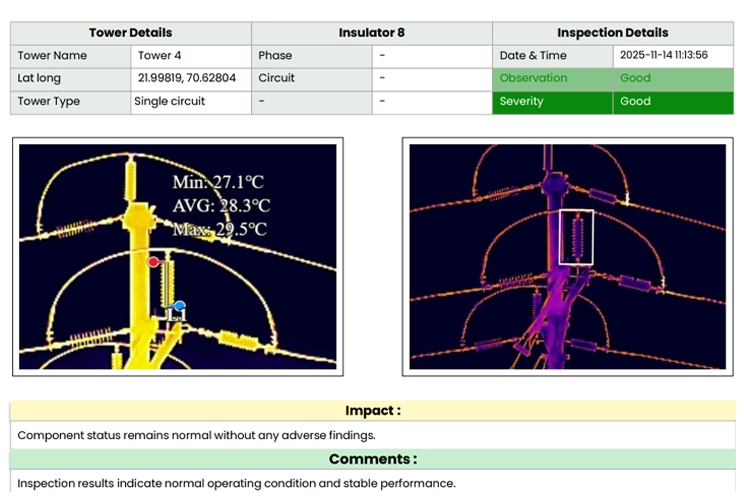
The Zenmuse H20T radiometric thermal camera captures temperature distribution data across all insulator strings, jumper connections, and hardware fittings simultaneously with the visual pass. Min/avg/max temperature values are logged per component. Comparative thermal mapping across insulator strings identifies reverse thermal variation patterns in disc insulators differential temperature signatures indicating early-stage dielectric degradation months before physical failure. For installations in coastal Tamil Nadu, saline Gujarat, and industrially polluted Rajasthan corridors, findings are cross-referenced against IEC 60815 pollution severity zone (a–d) classifications for the specific installation environment.
Defect Classification & Severity Report
Every identified anomaly classified using the severity matrix: Good / Severity Level 3 (Preventive) / Severity Level 5 (Critical). A tower-by-tower defect matrix is compiled from visual and thermal evidence, geo-tagged and cross-referenced to the tower index from Step 1. Pix4D is used where tower structural mapping requires orthomosaic processing. The complete deliverable tower-wise inspection report, thermal analysis tables, geo-tagged defect map, and severity classification matrix is delivered within 21 days of fieldwork completion via the lesoko.com secure client dashboard.
What We Find
Defects Detected in 33kV Line Inspections
Defect identification alone does not enable O&M planning — priority does. When 65 of 106 towers on a single evacuation line require attention, the difference between a Severity Level 5 finding and Severity Level 3 determines whether corrective action happens before monsoon onset or in the next planned maintenance window. Lesoko’s classification framework maps directly to O&M action cycles and the documentation format required for lender IE reporting not just a findings log.
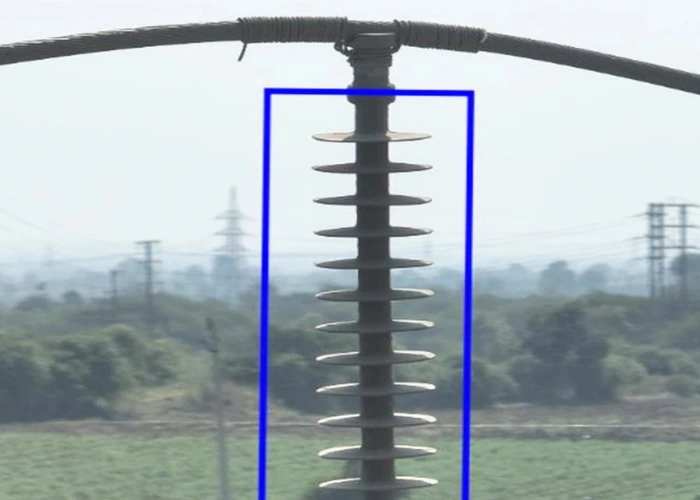
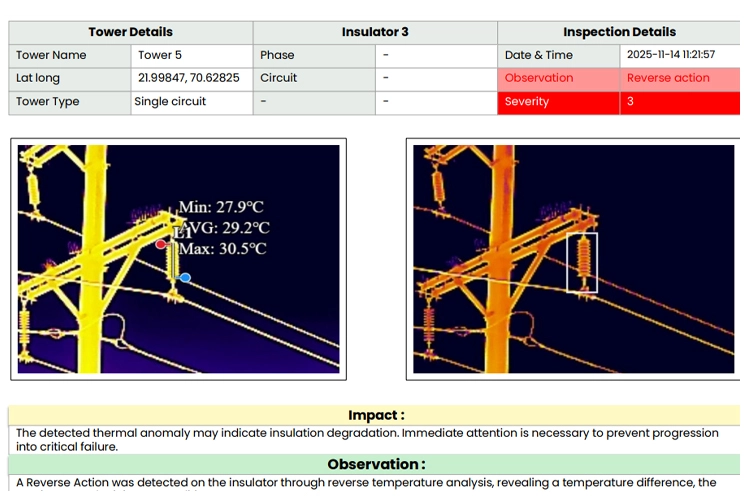
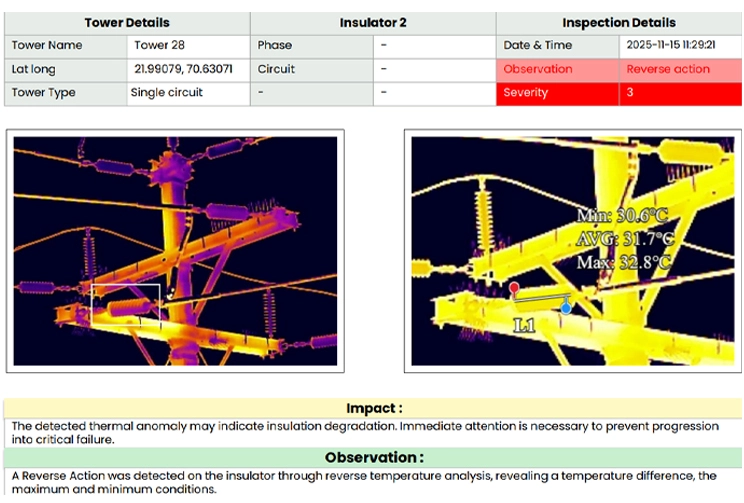
Reverse Thermal Variation — Disc Insulator String
Anomalous temperature differential across insulator disc surfaces detected through comparative IR mapping an early-stage degradation signal indicating progressive breakdown of insulating material, months before physical evidence appears. Not detectable by visual inspection under any conditions. Addressable within a planned O&M window; unaddressed, escalates to flashover risk under monsoon loading and high-pollution conditions.
Thermal Hotspot — Jumper Connection
Caused by connection oxidation, loose bolting, or partial conductor strand damage creating a high-resistance joint. Temperature differentials exceeding 25°C above adjacent conductor baseline indicate advanced arc flash risk under current IEC thermographic threshold criteria. Under sustained load, resistive heating escalates toward flashover threshold. Requires immediate corrective action before the next load cycle.
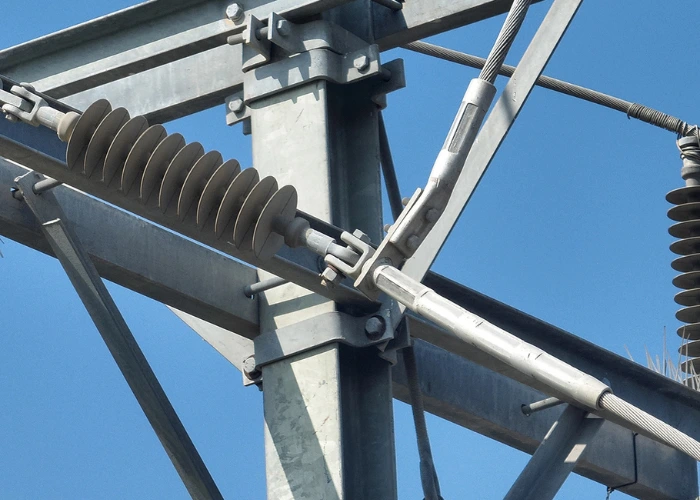
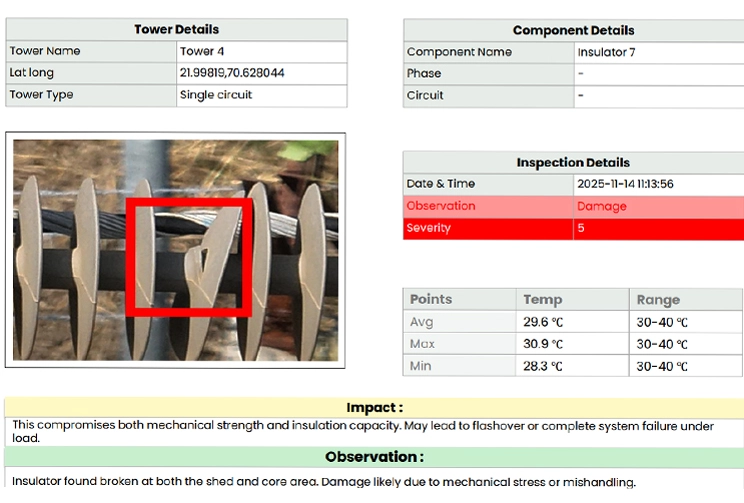
Mechanical Insulator Damage — Shed / Core Break
Physical cracking, shed fractures, or core breaks in suspension or strain insulators compromise both dielectric strength and the mechanical load-bearing capacity of the tower-to-conductor assembly. Reduced creepage distance increases flashover probability under IEC 60815 pollution severity ratings for the installation environment. Requires physical replacement on priority — failure mode is rapid once mechanical integrity is lost.
Conductor & Hardware Irregularities
Vibration damper displacement from installed position removes Aeolian vibration fatigue protection at suspension clamp interfaces. Armour rod slippage exposes conductor strand to bending fatigue at clamp entry points. Loose socket and clevis hardware introduces movement at the tower-to-insulator connection. Documented span-by-span with geo-tagged photographic evidence and addressed within planned maintenance windows before strand fatigue progresses.
Earthing Hardware Failure
Missing, corroded, or disconnected earthing conductors and bonding connections on tower structures represent direct safety-critical non-compliance with CEA (Measures Relating to Safety and Electric Supply) Regulations 2010. Consistently missed by ground patrol because earthing connection points are located at height on tower members. Every earthing hardware condition recorded in the tower-wise report per CEA compliance documentation requirements.
Structural Tower Anomalies
Missing, corroded, or disconnected earthing conductors and bonding connections on tower structures represent direct safety-critical non-compliance with CEA (Measures Relating to Safety and Electric Supply) Regulations 2010. Consistently missed by ground patrol because earthing connection points are located at height on tower members. Every earthing hardware condition recorded in the tower-wise report per CEA compliance documentation requirements.
Corona Discharge Indicators
Surface discharge activity on aged insulators or contaminated hardware identified via thermal signature and close-range visual inspection during energised operation. Indicates insulator surface degradation and line contamination particularly relevant in saline coastal environments and high-pollution industrial corridors. Catalogued for trend monitoring and cross-referenced against IEC 60815 pollution severity zone classification for the installation site.
Conductor Sag & Bird Guard Condition
Conductor sag deviation from design specification assessed via span-level drone passes deviation affects safety clearance to ground and vegetation, representing a regulatory non-compliance risk under CEA Regulations 2010. Bird guard damage or missing placements catalogued per tower with photographic evidence, affecting both equipment protection at insulator attachment points and wildlife compliance obligations for the installation corridor. Classified Severity 3 with replacement in next access window.
Pre-Monsoon Inspection Window: March–May
For solar evacuation lines in Gujarat and Rajasthan, the pre-monsoon window closes in late May when monsoon-onset humidity, storm loading, and increased fault probability converge on uninspected infrastructure. O&M managers who identify and correct Severity Level 5 defects before June avoid the combination of emergency repair costs, restricted access conditions, and maximum-consequence outage risk. Lesoko deploys on standard 5–7 day mobilisation timelines from enquiry to field. Contact us now to confirm deployment availability before the window closes.
Case Study · Gondal, Gujarat · 14–19 November 2025
30.13 MW Solar IPP — 33kV Evacuation Line, 106 Towers
106 towers assessed · 14–19 November 2025 · Lesoko Technologies
A utility-scale solar IPP operating a 30.13 MW project at Gondal, Gujarat required a full tower-level assessment of their 33kV evacuation line ahead of an annual O&M cycle and an upcoming lender review. The prior inspection cycle — conducted by conventional ground patrol — had returned no significant findings. Lesoko deployed a DGCA-certified team across six working days, completing visual and IR thermographic inspection of all 106 towers. The findings revealed critical or preventive defects in 65% of towers — none of which had appeared in the prior manual inspection cycle.
Tower Classification Results — All 106 Towers
Who We Serve
Transmission Inspection Across Solar, Wind, and Utility Sectors
IPP Asset Manager / O&M Manager
The 33kV evacuation line is the highest-consequence unmonitored asset in a utility-scale solar plant. A thermal fault developing for months on a jumper connection does not appear in O&M logs, does not generate SCADA alerts, and does not show in a ground patrol report until it causes a forced outage affecting generation, PPA metrics, and lender standing simultaneously. Lesoko provides the inspection format that closes that monitoring gap: tower-level thermal data, severity-classified outputs, and a geo-tagged defect map that feeds directly into the next maintenance mobilisation.
EPC Contractor
Handover and pre-commissioning inspection of the 33kV evacuation line is a lender requirement at financial close but construction programme pressure and the documentation limitations of climbing teams mean that the commissioning inspection frequently does not produce the IE-ready evidence lenders require. Lesoko delivers a complete pre-commissioning inspection within the construction handover window: energised-line drone inspection, DGCA-certified, with tower-indexed thermal and visual outputs in a lender-accepted format. No shutdown coordination required; no programme extension needed.
Lender IE / Technical Advisor · DISCOM
For IE firms conducting transmission assessments for project finance, refinancing, or insurance, the limiting factor is often the quality of base inspection data available. Informal maintenance records and visual-only reports do not provide the thermal evidence required for a defensible IE assessment. For DISCOMs and TRANSCOs, Lesoko supports vendor empanelment and rate-contract inspection programmes aligned to CEA Regulations 2010 and applicable RERC/SERC compliance documentation requirements. Report formats are accepted by TNEB, grid operators, and lender technical advisors across all major solar states.
Pan-India Deployment — All Major Solar and Wind States
Lesoko operates pan-India with DGCA-certified inspection teams deployable across all major solar and wind states without local mobilisation constraints. Gujarat where the published Gondal case study was completed on a 30.13 MW IPP evacuation line and Rajasthan represent the highest deployment volume, reflecting India’s largest utility-scale solar installation base. Tamil Nadu operations are established through existing client engagements with TNEB, which operates both distribution and transmission infrastructure across the state. Karnataka, Andhra Pradesh, and Maharashtra are served by teams based in Chennai, with corridor projects across the Pavagada, Kurnool, and Vidarbha solar zones completed on standard mobilisation timelines. State-specific information on DISCOM and TRANSCO procurement processes is available for Gujarat and Tamil Nadu on request.
States served
- Gujarat
- Rajasthan
- Tamil Nadu
- Karnataka
- Maharashtra
- Andhra Pradesh
- Telangana
- Madhya Pradesh
- Uttar Pradesh
- Odisha
- Punjab
- Haryana
- Himachal Pradesh
- Uttarakhand
- Bihar
- Jharkhand
- Chhattisgarh
- West Bengal
- Kerala
- Assam
- Jammu & Kashmir
What You Receive
Report Deliverables — Every Inspection Engagement
Every Lesoko 33kV inspection engagement closes with a structured deliverable set built for three simultaneous uses: O&M team maintenance planning, IE reviewer due diligence, and asset management record-keeping. Standardised tower-indexed formats eliminate the translation step between inspection output and maintenance mobilisation engineering teams can act on Severity 5 findings immediately without re-interpreting source data.
Tower-Wise Inspection Report
Component-level findings for every tower · visual and thermal evidence per anomaly · primary technical record for O&M teams and IE reviewers.
Geo-Tagged Defect Map
GPS-coded anomaly locations matched to tower index · enables maintenance crew deployment to exact locations without a secondary survey.
Thermal Analysis Tables
Min/avg/max temperature per insulator string and jumper connection · evidential basis for severity classification and IE reporting requirements.
Severity Classification Matrix
Good / Severity Level 3 / Severity Level 5 per component, per tower · directly outputs a prioritised maintenance schedule for the O&M cycle.
Maintenance Recommendations
Prioritised corrective action list for engineering and O&M teams. sequenced by severity classification, not by tower number.
Client Dashboard Access
Secure portal at lesoko.com · all thermal images, defect maps, and tower reports downloadable. ISO 9001 data security compliance.
We use high-resolution drones and advanced thermal imaging systems to capture precise, tower-level data that supports planning, engineering analysis, and transmission asset reliability.
Identify Transmission Faults Before They Become Forced Outages
Phone/ Whatsapp
7845726374
Email Us
sales@lesoko.in
Visit Us
2nd Floor, Chettinad Chambers, P.S.Sivasamy Salai 1st Street, Mylapore, Chennai, Tamil Nadu 600004
Send Inspection Request
Frequently Asked Questions
Yes. Drone-based 33kV transmission line inspection is conducted on fully energised lines. Lesoko’s DGCA-certified remote pilots operate under UAS Rules 2021 proximity protocols for HT-line infrastructure no de-energisation, no SLDC outage window, and no generation downtime required. This is the primary operational advantage over conventional climbing inspection, which requires either a scheduled shutdown or the safety constraints of live-line working.
A 33kV inspection covers every tower from the solar plant substation to the grid injection point insulator strings (suspension and strain types), jumper connections, conductor hardware, vibration dampers, armour rods, earthing conductors, anti-climb devices, bird guards, structural members, and cross-arms. For solar evacuation lines, the inspection extends to substation bay termination connections and transformer bay hardware where elevated thermal fault risk is common. Every component is assessed visually and thermally and documented tower-by-tower with geo-tagged evidence.
Reverse thermal variation is an anomalous differential in temperature distribution across the surface of a disc insulator, detected through comparative IR thermographic mapping during energised operation. It indicates progressive degradation of the insulating material A pre-failure signal appearing months before any physical evidence is visible to inspection. In coastal Tamil Nadu and saline Gujarat environments, IEC 60815 pollution severity zone ratings amplify failure progression. Classified Severity Level 3 (Preventive), it is addressable within a planned O&M window but unaddressed, it escalates to flashover risk under monsoon loading.
Field inspection of a 100-tower evacuation corridor typically takes 5–7 working days, covering 15–25 towers per day depending on terrain, access conditions, and line configuration. Full report delivery. Tower-wise inspection report, thermal analysis tables, geo-tagged defect map, and severity classification matrix is completed within 21 days of fieldwork completion. For pre-monsoon or lender-deadline engagements, project-specific timelines are confirmed during the initial scoping call.
A lender IE-accepted 33kV transmission inspection report includes: a tower-wise assessment with component-level findings and photographic evidence for every tower; thermal analysis tables with min/avg/max temperature readings per insulator string and jumper connection; a geo-tagged defect map with GPS-coded anomaly locations; a severity classification matrix (Good / Severity Level 3 / Severity Level 5) per component; and prioritised maintenance recommendations. The report must be produced by a third-party operator independent of the EPC and O&M contractor, with DGCA Remote Pilot Licence documentation included. Lesoko’s standard report format is accepted for project finance due diligence, PPA compliance, insurance renewals, and CERC grid code documentation.
Thermal hotspot detection uses infrared (IR) thermography to identify abnormal temperature concentrations in conductor jumper connections, insulator strings, and bolted hardware fittings on 33kV transmission towers. Hotspots indicate high-resistance joints, loose hardware, or degraded contacts where electrical resistance converts current to heat a precursor to arc flash and forced line shutdown if not addressed. IR thermal cameras log minimum, maximum, and average temperatures per component for quantified severity assessment.
Field inspection of 100 towers typically requires 5–7 working days, covering 15–25 towers per day depending on terrain, access conditions, and corridor layout. Full report delivery including tower-wise findings, thermal analysis tables, geo-tagged defect map, severity classification matrix, and maintenance recommendations is completed within 21 days of fieldwork completion. Accelerated turnaround for pre-commissioning or lender IE deadlines is available on request during project scoping.
The minimum recommended frequency is annual, with a pre-monsoon cycle as the operationally critical inspection window — thermal faults building through the summer load season need to be identified and corrected before monsoon-onset humidity and storm loading escalate failure probability. Additional inspection triggers include: pre-commissioning and handover (required for lender sign-off at financial close); post-fault or post-storm events; lender due diligence reviews; insurance renewals; and asset monetisation or refinancing processes. An annual contract with Lesoko establishes the baseline thermal profile data required for trend monitoring across inspection cycles.