
Here’s something most drone guides won’t tell you: India’s biggest inspection problem isn’t the technology. It’s that plant managers and asset owners are still sending humans into dangerous situations they don’t need to be in.
A few months ago, a power transmission company in Rajasthan shut down a 132 kV tower for 11 hours to inspect corrosion on three bolts. Cost: ₹18 lakh in downtime. Time lost: one full working day for a crew of six. Outcome: a two-page inspection report and one worried engineer.
A drone would have done it in 40 minutes, from the ground, while the tower kept transmitting.
This is the real case for Unmanned Aerial Vehicles (UAVs) in India not the technology for its own sake, but the measurable, practical difference it makes when you replace the old way of doing things with something genuinely better.
This guide is written for decision-makers: operations managers, infrastructure heads, renewable energy developers, and procurement teams. If you’re evaluating drone inspection services or trying to understand where UAVs fit in your sector, you’re in the right place.
Table of Contents
What Is a UAV? (And Why the Terminology Matters in India)
An Unmanned Aerial Vehicle (UAV) is any aircraft that operates without a pilot physically aboard. The pilot either controls it remotely from the ground or sets it up to fly autonomously using pre-programmed instructions.
Simple enough. But in India, the terminology you use actually matters. Especially when dealing with regulators, insurance providers, and government tenders.
| Term | What It Means | Where You’ll See It |
|---|---|---|
| UAV | Unmanned Aerial Vehicle — the aircraft itself | Technical specs, reports, tenders |
| Drone | Informal term for UAV; widely used | Media, marketing, everyday conversation |
| RPAS | Remotely Piloted Aircraft System | DGCA regulations, legal documents |
| UAS | Unmanned Aircraft System. Aircraft + ground station + links | Technical contracts, defence procurement |
| RPA | Remotely Piloted Aircraft DGCA’s term for the aircraft | Drone Rules 2021, UIN registration |
When you’re issuing an RFP or reviewing a vendor’s compliance documents, look for RPAS and RPA. Those are the terms DGCA uses in Drone Rules 2021. A vendor that only talks in vague “drone” language without referencing DGCA-specific terminology may not be as compliance-savvy as they appear.
Why India’s Drone Moment Is Happening Right Now
India’s drone sector didn’t grow gradually. It exploded.
Between 2021 and 2024, registered drones on the Digital Sky Platform went from near-zero to over 3.5 lakh registered aircraft. That’s not organic growth — it’s the direct result of policy reform, and it has created a commercial services market that simply didn’t exist three years ago.
| ₹8,300 Cr | 3.5L+ | 23% CAGR | ₹120 Cr |
| Projected drone market by 2028 (FICCI) | Drones registered on Digital Sky | Expected market growth rate | Central PLI scheme for drone manufacturers |
Three forces are driving this:
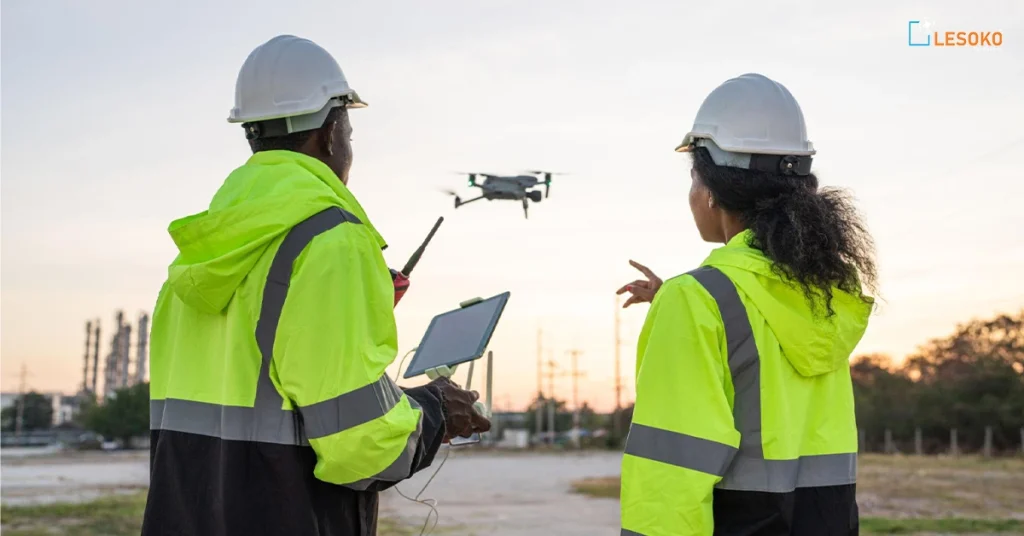
Renewable energy scale: India’s 500 GW solar target by 2030 means tens of thousands of plants that need regular inspection. Manual panel-by-panel checking at this scale is economically impossible.
Policy reform: Drone Rules 2021 replaced a restrictive framework with one that actually works for commercial operators. No-permission zones shrank. Registration became digital. Red tape reduced substantially.
Infrastructure demand: India’s ₹111 lakh crore National Infrastructure Pipeline needs monitoring. Roads, bridges, dams, transmission lines. Physical inspection at this scale is only feasible with UAVs.
💡 Key Insight
India’s commercial drone services sector is growing faster than drone hardware manufacturing. The FICCI-ICEA joint report projects drone services (DaaS) growing at 28–32% CAGR through 2028. Making it the highest-value segment in the entire drone ecosystem.
How a Commercial UAV Actually Works in the Field
When Lesoko deploys a UAV for an industrial inspection, it’s not just a “flying camera.” It’s a coordinated system and the value isn’t in the flight, it’s in what comes after.
Before the Flight: Mission Planning
Every commercial UAV operation starts on the ground sometimes days before the aircraft takes off. The mission planning phase includes:
- Airspace verification on DGCA’s Digital Sky Platform to confirm green-zone status at the site
- Flight path programming using software like DJI Pilot 2, Pix4Dcapture, or Mission Planner
- Sensor configuration — thermal camera settings, overlap percentages for photogrammetry, flight altitude calibration
- Risk assessment and emergency procedure briefing for the pilot team
During the Flight: What the Sensors Capture
A professional inspection drone carries more than one sensor. At Lesoko, our inspection aircraft typically combine:
Radiometric Thermal Infrared Camera
Detects temperature anomalies in solar panels, electrical components, building facades, and pipelines. Can identify a failing solar cell before it causes string-level losses.
High-Resolution RGB Camera
captures detailed visual imagery for crack mapping, corrosion identification, structural deformation analysis.
LiDAR Scanner
creates precise 3D point clouds. Used in mining volumetrics, vegetation encroachment mapping, and terrain modelling.
Multispectral Sensor
captures NDVI, NDRE, and other vegetation indices for precision agriculture and crop health assessment.
Gas Detection Sensor
Identifies methane, CO₂, VOC leaks along pipelines and around refinery equipment.
After the Flight: Where the Real Value Is Created
Raw drone footage is not a deliverable. It’s raw material. The value is extracted through processing:
- Photogrammetry software (Pix4D, Agisoft Metashape) converts overlapping images into georeferenced orthomosaic maps and 3D models
- Thermal analysis software (FLIR Research Studio) processes radiometric data into hotspot reports with GPS coordinates
- GIS platforms export data layers compatible with the client’s asset management system
- Engineering review produces actionable inspection reports with defect severity ratings and maintenance recommendations
The drone is 10% of the value. The mission planning, sensor calibration, data processing, and engineering interpretation that’s the 90% that separates a drone services professional from someone with a drone.
— Lesoko Field Operations Team
DGCA Rules 2021: What Business Buyers Must Verify
This section could save your company significant trouble. India’s Drone Rules 2021 are comprehensive and non-compliance is an organisational risk, not just a vendor problem.
When a drone service provider operates without proper certification on your site, your organisation can face regulatory scrutiny regardless of the fact that you didn’t own or operate the drone.
The 5-Point Compliance Checklist
Before signing any drone services contract, verify these five things:
| # | Requirement | How to Verify | Risk if Missing |
|---|---|---|---|
| 1 | UIN Registration | Ask for Digital Sky Platform screenshots showing registered UIN for each aircraft | Illegal operation; your site implicated |
| 2 | Remote Pilot Certificate (RPC) | Request RPC documents for every pilot on the project | Uncertified operation; no insurance validity |
| 3 | Airspace Permission | Confirm DGCA airspace clearance process for your site location before project start | Flight in restricted airspace; criminal liability |
| 4 | Third-Party Insurance | Request a copy of insurance certificate covering the specific project dates | No coverage for accidents; your asset liability |
| 5 | Type-Certified Aircraft | Confirm drones have DGCA type certificate or import clearance | Void insurance; regulatory seizure of aircraft |
Red Flag Alert
If a drone vendor cannot immediately provide UIN numbers and RPC certificates on request walk away. In India’s commercial drone market, non-compliant operators are common, especially in the ₹5,000–₹15,000 per-day freelance market. Price is not the right filter. Compliance documentation is.
Where UAVs Are Delivering Real ROI Across Indian Industries
Let’s go sector-by-sector not with generic claims, but with the specific problems UAVs solve and the numbers behind them.
Solar Energy: The Biggest Commercial Opportunity
India added over 18 GW of solar capacity in FY2024 alone. Every one of those megawatts contains panels that need inspection ideally twice a year.
The problem with manual inspection: at a 100 MW plant containing roughly 3 lakh panels, a ground team of 10 inspectors takes 3–4 weeks to complete a visual check. They miss buried cell defects invisible to the naked eye. They cause panel damage through physical handling. A drone-based thermal inspection does the same 3 lakh panels in 1.5–2 days. The thermal camera sees hotspots caused by cell breakdown, bypass diode failure, soiling patterns, and interconnect corrosion. All precisely GPS-tagged for maintenance teams.
The ROI case: A study across 12 utility-scale solar plants in India found that drone thermography identified an average 2.3% of panels with performance-impacting defects that had never been detected in previous manual inspections. On a 100 MW plant generating ₹5 crore/month, 2.3% underperformance translates to ₹13.8 lakh in monthly generation losses. Recoverable through targeted maintenance.
Telecom: The Safety Argument Is Overwhelming
India has over 7 lakh telecom towers. Tower climbing is among the most dangerous jobs in the country fall fatalities are a persistent industry problem with no good manual alternative.
A drone inspection of a typical 40-metre telecom tower takes 45–90 minutes and produces HD photographs of every structural element, antenna mount, cable route, and connection point. A climber inspection of the same tower takes 4–6 hours with two-person safety protocols and exposes human beings to significant fall risk.
For towercos managing portfolios of thousands of towers across multiple states, the shift to drone-first inspection is not a cost choice. It’s a liability management decision.
Infrastructure: Bridges, Dams & Highways
India has over 1.5 lakh bridges on the national highway network, thousands of which are rated structurally deficient. The inspection backlog is staggering. A conventional bridge inspection with scaffold access, underwater diving, and lane closure costs ₹4–15 lakh per bridge and requires days of closures.
Drone-based bridge inspection using photogrammetry creates a georeferenced 3D model of the entire bridge structure. Deck, girders, bearings, piers, abutments that engineers can inspect remotely, measure digitally, and compare year-on-year for change detection.
Field Example
An NHAI contractor in Madhya Pradesh used Lesoko's drone inspection service for a portfolio of 22 bridges during a routine structural assessment cycle. Total time: 11 days. Cost: 35% of the equivalent scaffold-based inspection budget. Deliverable: 3D models + defect maps + comparative analysis against previous year's survey — a data quality level simply not achievable manually.
Mining: Volumes Don’t Lie
Open-cast mines need accurate stockpile volumetrics for production accounting, royalty calculations, and export documentation. Traditional total station surveys take 2–4 days per large mine and have ±5% variance at best.
Drone photogrammetry surveys a 200-hectare mine in 6–8 hours. With RTK GPS, accuracy reaches ±2–3 cm horizontally. Volume calculations are automated. The mine keeps operating during the survey. Reports are ready within 48 hours.
Agriculture: The Scale Challenge
India’s agricultural area covers 140 million hectares. Crop health monitoring and precision input application at this scale is genuinely unsolvable without aerial technology.
Multispectral drones create NDVI and NDRE maps that identify stress zones, pest damage, and nutrient deficiency weeks before symptoms are visible to the naked eye enabling targeted interventions that reduce input costs by 20–30% while improving yield.
Drone Inspection vs. Traditional Methods
This isn’t a one-sided argument. There are situations where traditional inspection is still the right call. Here’s the honest breakdown:
| Traditional Inspection | Drone Inspection |
| Slow: weeks for large assets | Fast: hours, not days |
| Expensive: scaffolding, cranes, labour | Cost: 40–75% less than traditional |
| Safety risk: heights, confined spaces | Zero human risk at height |
| Visual-only: misses subsurface defects | Multi-sensor: thermal, LiDAR, RGB |
| Paper-based: hard to compare over time | Georeferenced digital data |
When Traditional Inspection Is Still Necessary
Drones can’t do everything. Traditional methods remain necessary when:
- Physical samples need to be collected (concrete cores, material specimens)
- Regulatory standards mandate hands-on inspection (certain pressure vessel standards)
- Subsurface or internal inspection is required (pipework interiors, concealed structures)
- Confined space entry is needed for close-range measurement
The best inspection programmes combine drone-first assessment with targeted manual follow-up using drone data to direct where human effort is most needed.
How to Choose the Right Drone Inspection Partner in India
The drone services market in India has grown fast which means it’s also crowded with operators at very different levels of professionalism. Here’s a practical framework for vendor evaluation:
- Ask for the compliance pack first. Before discussing scope or pricing, request UIN numbers, RPC certificates for the pilot team, and proof of insurance. If it takes more than 24 hours to provide, move on.
- Request sector-specific case studies. A vendor who has done 50 solar inspections understands panel-level reporting formats, string correlation data, and O&M integration. A general drone operator does not.
- Evaluate the deliverable, not the flight. Ask to see a sample inspection report from a comparable project. The deliverable format not the drone specs determines your operational value.
- Test their geographic coverage. India is large. If your assets span multiple states, verify the vendor has active pilot coverage not just claimed coverage in each geography. Ask who handles airspace permissions in Himachal Pradesh versus Tamil Nadu.
- Assess turnaround and SLA. A three-week report turnaround is not useful for operational decision-making. Standard for professional inspection services should be 48–72 hours from flight completion to final report delivery.
Lesoko covers 22+ states, delivers reports in 48 hours, and every project is backed by full DGCA compliance documentation. Get a project-specific quote in 24 hours.
Unmanned Aerial Vehicles are not a future technology in India. They are a present-tense operational tool that is already changing how India’s infrastructure is built, monitored, and maintained.
The companies seeing the biggest returns aren’t the ones with the most advanced drones. They’re the ones who have integrated UAV data into their maintenance decision-making, their asset management systems, and their planning cycles.
If you’re still assessing whether drones are “ready” for your sector, you’re asking yesterday’s question. The question for 2026 is: which drone inspection model is right for your assets, your geography, and your operational rhythm?
That’s a question Lesoko can help you answer with a site-specific inspection plan, transparent pricing, and the track record to back it up.
Frequently Asked Questions
What is an unmanned aerial vehicle and how is it used in India?
An Unmanned Aerial Vehicle (UAV) also called a drone or RPAS is an aircraft that operates without a human pilot onboard. In India, UAVs are used commercially for industrial inspection (solar panels, telecom towers, oil pipelines), infrastructure surveys (bridges, dams, highways), precision agriculture, mining surveys, and disaster management. Commercial drone operations are fully legal under DGCA’s Drone Rules 2021, and India’s drone services market is projected to reach ₹8,300 crore by 2028.
Is drone operation legal in India? What are the rules?
Yes, commercial drone operations are fully legal in India under the Drone Rules, 2021 (notified August 25, 2021). Key requirements: drones must be registered on the Digital Sky Platform with a Unique Identification Number (UIN); pilots must hold a valid Remote Pilot Certificate (RPC); airspace permission must be obtained before each flight via the Digital Sky Platform; and third-party liability insurance is mandatory. Lesoko operates in full compliance with all DGCA requirements across India.
What is the difference between UAV, drone, UAS, and RPAS?
UAV (Unmanned Aerial Vehicle) refers specifically to the aircraft itself. Drone is the popular informal term covering the same thing. UAS (Unmanned Aircraft System) is a broader term covering the full system. Aircraft plus ground control station, communication links, and software. RPAS (Remotely Piloted Aircraft System) is DGCA’s preferred regulatory term in India, used in Drone Rules 2021. For regulatory documents and formal contracts in India, RPAS and RPA are the correct terms to use.
What is Drone-as-a-Service (DaaS) and why is it better than owning drones?
Drone-as-a-Service (DaaS) is a model where your organisation hires a certified drone services company for specific inspection or survey tasks rather than purchasing hardware, hiring pilots, managing DGCA compliance, and maintaining equipment yourself. For most companies doing 4–12 inspection campaigns per year, DaaS delivers 50–70% cost savings compared to an in-house programme. You also get access to multi-sensor capabilities (thermal, LiDAR, multispectral) that no single in-house setup economically justifies.
Which industries benefit most from drone inspection services in India?
The highest-impact industries for drone inspection in India are: Solar energy (panel thermography, hotspot detection), Telecom (tower structural audit replaces dangerous tower climbing), Oil & Gas (pipeline patrol, leak detection, refinery inspection), Infrastructure (bridges, dams, highways — photogrammetric 3D modelling), Mining (volumetric stockpile surveys, slope monitoring), and Agriculture (crop health mapping, precision spraying coordination). Lesoko serves all these sectors with dedicated inspection workflows for each.
How accurate are drone surveys compared to traditional land surveys in India?
Drone surveys using RTK GPS (Real-Time Kinematic positioning) achieve horizontal accuracy of ±1–3 cm and vertical accuracy of ±2–5 cm. With Ground Control Points (GCPs), this improves further for engineering-grade deliverables. For mining stockpile volumes, drone photogrammetry consistently achieves within 1–3% variance of traditional total station surveys at a fraction of the cost and time. For most commercial inspection and survey applications in India, drone accuracy meets or exceeds project requirements.