

Here is something most project managers in India do not know: a 500-acre land survey that used to take three weeks and cost ₹10 lakh can now be done in two days at ₹2.5 lakh with better accuracy. That is the real-world impact of geospatial solutions.
India is building at a pace the country has never seen before. Highways, solar parks, smart cities, transmission networks every one of these projects runs on data. Specifically, on spatial data. And the organizations that get that data faster, cheaper, and more accurately than their competitors are the ones finishing projects on time, catching problems early, and winning the next contract.
Yet many decision-makers still default to traditional surveying, manual inspections, and outdated satellite images. They do not realize that the technology gap between what they are using and what is now available has grown into a serious business risk.
This guide is written for infrastructure owners, solar developers, EPC contractors, and government project managers in India who want a clear, jargon-free explanation of what geospatial solutions actually are and how to put them to work in 2026.
Table of Contents
What Are Geospatial Solutions?
Let’s strip away the technical language for a moment.
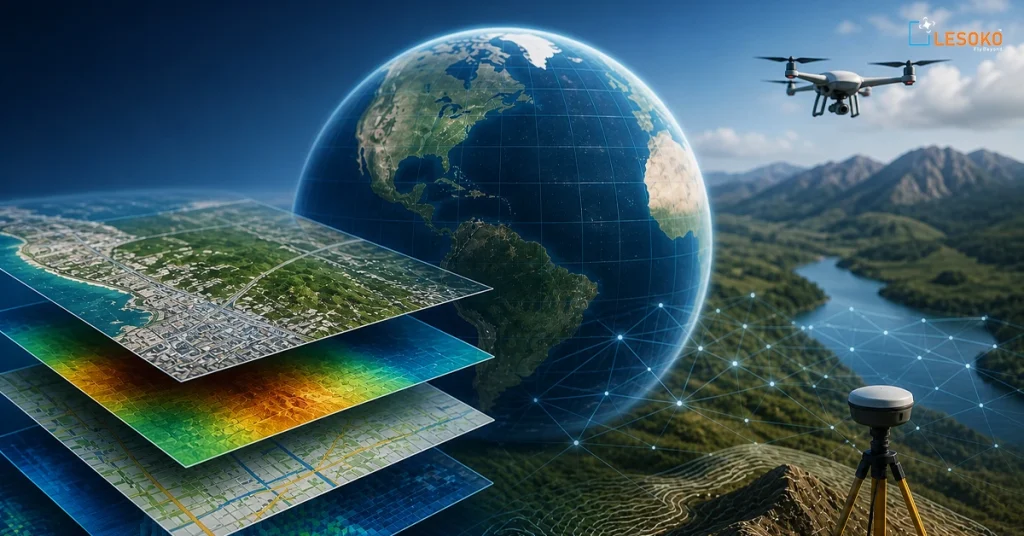
A geospatial solution is simply a way to collect, process, and use information that is tied to a physical location on Earth. That location data might come from a drone flying over a solar plant, a LiDAR scanner mapping a transmission corridor, a GPS receiver marking property boundaries, or a satellite capturing a city’s growth over time.
The output is always the same: A precise, digital picture of a real-world place. Accurate enough to make decisions you could not make before.
“A geospatial solution turns physical space into actionable data. Everything else is detail.” — Lesoko GIS Team
The One-Sentence Definition
| DEFINITION |
| Geospatial solutions are technology-driven services that capture, process, and visualize data linked to specific geographic locations using tools like drones, LiDAR, GIS software, GPS, and satellite imagery to help businesses, governments, and engineers make better spatial decisions. |
The 6 Core Technologies Inside a Geospatial Solution
No single technology does everything. Real-world geospatial projects combine multiple tools. Here is what each one does and what it is best for in the Indian context.
| Technology | What It Does + Best Indian Application |
| Drone / UAV | Low-altitude aerial data capture. Best for solar inspection, land survey, construction monitoring, and transmission line assessment across India’s varied terrain. |
| LiDAR (Laser Scanning) | Fires laser pulses to build 3D models even through tree canopy. Essential for railway/highway corridor surveys, flood plain mapping, and power line sag measurement. |
| GIS Software | Stores, layers, and analyzes spatial datasets on a digital map. Used by municipalities for urban planning, by utilities for asset management, by state governments for disaster response. |
| Photogrammetry | Converts thousands of overlapping drone photos into georeferenced 3D maps. The workhorse of land surveys, volumetric calculations, and construction monitoring. |
| GPS / GNSS RTK | Provides centimeter-level ground accuracy for drone surveys and boundary marking. Required for NHAI, AAI, and state revenue board compliant deliverables. |
| Multispectral / Thermal IR | Captures wavelengths invisible to the human eye. A thermal camera detects hot solar panels, overloaded cables, and water stress in crops. |
Why India’s Infrastructure Boom Is Driving Demand for Geospatial Solutions
India’s infrastructure ambition is extraordinary by any measure. But ambition without accurate data leads to cost overruns, legal disputes, and missed deadlines. That is the gap geospatial solutions fill.
The Numbers That Tell the Story
- India plans to spend ₹143 lakh crore on infrastructure between 2024 and 2030 under the National Infrastructure Pipeline (NIP)
- The Ministry of New and Renewable Energy (MNRE) targets 500 GW of renewable energy capacity by 2030. Requiring precise land identification and O&M efficiency
- India’s geospatial sector is projected to reach USD 63 billion by 2026, growing at 12.8% CAGR (FICCI-EY Report, 2023)
- The National Geospatial Policy 2022 removed restrictions on private-sector spatial data collection opening the market to companies like Lesoko
- DGCA registered over 32,000 drones in India as of early 2026. 400% increase in three years
What this means in practice: every highway tender, every solar project DPR, every smart city plan is now competing for the same scarce resource. Reliable spatial data. The organizations that secure it faster win.
“In the last two years, we have seen a fundamental shift. Clients are not asking us IF they need drone data anymore. They are asking HOW FAST we can deliver it.”
Geospatial Solutions Across India’s Key Industries
Solar Energy: The Fastest-Growing Application
India crossed 80 GW of installed solar capacity in 2025. Managing this capacity efficiently is a massive operations challenge. And geospatial technology is becoming the backbone of solar O&M in India.
Here is the core problem: a thermal anomaly on a single solar string can cause up to 20% power loss in that string. Multiply that across a 100 MW plant, and you are losing ₹60–90 lakh annually in generation revenue from a fault that costs ₹800 to fix if you catch it.
Drone-based thermal inspection using radiometric infrared cameras (FLIR / Zenmuse XT2) identifies faulty panels, bypass diode failures, soiling patterns, and PID degradation in hours not days. A single Lesoko inspection typically recovers 3–5% of annual generation for a 10 MW plant.
| SOLAR INSPECTION — KEY FACTS (LESOKO DATA) |
| Coverage speed: 5–10 MW inspected per day per drone team Detection accuracy: 96.4% confirmed defect rate (cross-validated against string-level monitoring data) Report standard: IEC 62446-3 compliant thermal inspection report Geographic reach: 18 states including Rajasthan, Gujarat, AP, Tamil Nadu, Karnataka, Maharashtra, UP Average ROI: 10–18x inspection cost in recovered generation revenue |
Infrastructure Surveys: Roads, Railways, and Highways
Before any road is built, someone has to map the terrain. Traditionally, this meant weeks of ground survey teams working with total stations and GPS rovers. One crew might cover 3–5 km per day on a highway alignment.
A drone photogrammetry team covers 60–100 km of corridor per day, producing digital elevation models, contour maps, and orthophotos to NHAI specifications. The data quality is often superior to ground survey fewer human errors, complete area coverage, and a permanent digital record for dispute resolution.
- Use case: NHAI expressway pre-DPR topographic survey — 450 km mapped in 9 days
- Use case: State PWD road resurfacing — drone-based road condition index mapping of 800 km network
- Use case: Railway alignment feasibility study with LiDAR terrain model under dense tree cover
Power Transmission and Distribution Networks
India has over 4.5 lakh km of transmission lines. Inspecting them manually on foot or by helicopter is dangerous, slow, and increasingly unaffordable for state utilities. The result: many defects go undetected until they cause a fault.
Drone inspection of transmission towers captures high-resolution visual data, thermal anomalies on connectors and insulators, and LiDAR-based sag measurements — all in a single pass. A team of two drone operators can inspect 15–20 towers per hour.
Transmission Inspection: what drones detect
- Insulator flashover damage and conductor corrosion
- Hot joints and overloaded connectors (thermal camera)
- Vegetation encroachment within safety clearance zones
- Tower structural damage (post-cyclone or earthquake)
- Conductor sag exceeding design limits (LiDAR measurement)
- Bird nest accumulation on cross-arms
Construction Monitoring and Volume Tracking
Large EPC contractors in India are discovering that weekly drone flights over active construction sites pay for themselves. Many times over.
Cut-fill volume calculations from drone photogrammetry eliminate billing disputes with subcontractors. Progress photos with GPS timestamps create a legally defensible record. And comparing planned versus actual progress lets project managers catch slippage before it compounds.
- One National Highway project saved ₹1.8 crore in disputed earthwork billing using Lesoko volumetric surveys
- A solar EPC company reduced project completion time by 11 days by identifying a civil contractor delay via drone progress monitoring in Week 3 of construction
The Real Cost of NOT Using Geospatial Solutions
This is the section most vendors skip. But it matters because the status quo has a price.
| The Traditional Approach | The Hidden Cost |
| Manual solar panel inspection (thermography team on foot) | 5–7 days per 10 MW. ₹2.5–4.5 lakh per inspection. High risk of missed defects due to sampling. |
| Ground survey for 1,000-acre site | 3–4 weeks. ₹8–12 lakh. High error rate at plot boundaries. No 3D terrain model. |
| Helicopter transmission line inspection | ₹1.5–2.5 lakh per km. Weather-dependent. No thermal data. No LiDAR. |
| Paper-based construction monitoring | Monthly site visits. No volumetric tracking. Billing disputes often settled by gut feel. |
| Satellite imagery for crop/solar analysis | 2–5 m resolution. Cannot detect individual panel faults. Cloud-cover gaps in monsoon. |
The decision to avoid geospatial technology is never truly a cost-saving decision. It is a decision to pay the cost later in lower generation yields, in legal disputes, in project delays, in budget overruns.
How to Choose a Geospatial Solutions Partner in India
The drone inspection and geospatial survey market in India has grown fast. That means more options and more ways to make the wrong choice. Here is what to verify before you sign a contract.
DGCA Compliance
All commercial drone operations above 250 grams in India require DGCA-registered aircraft (with a Unique Identification Number), operators with a valid Remote Pilot Licence (RPL), and clearance through the Digital Sky Platform for each mission.
Ask your vendor for their UIN numbers and RPL certificates before any project discussion. A vendor who cannot produce these immediately is not a qualified operator.
Sensor Technology and Data Quality
Not all thermal cameras are the same. A radiometric thermal camera (such as FLIR Tau 2 or Zenmuse XT2) measures absolute temperature at every pixel enabling standardized defect classification. A non-radiometric camera only shows relative temperature differences. For solar inspection, only radiometric data meets IEC 62446-3 standards.
In-House Processing vs. Outsourced
Some companies fly drones but send raw data offshore for processing. This adds 7–14 days to turnaround time and creates data security risks. Ask specifically: who processes your data, where, and how is it secured?
Industry-Specific Experience
Drone surveying for a construction site and drone inspection for a 300 MW solar park require very different expertise. Ask for case studies from your specific sector.
A Typical Geospatial Project with Lesoko
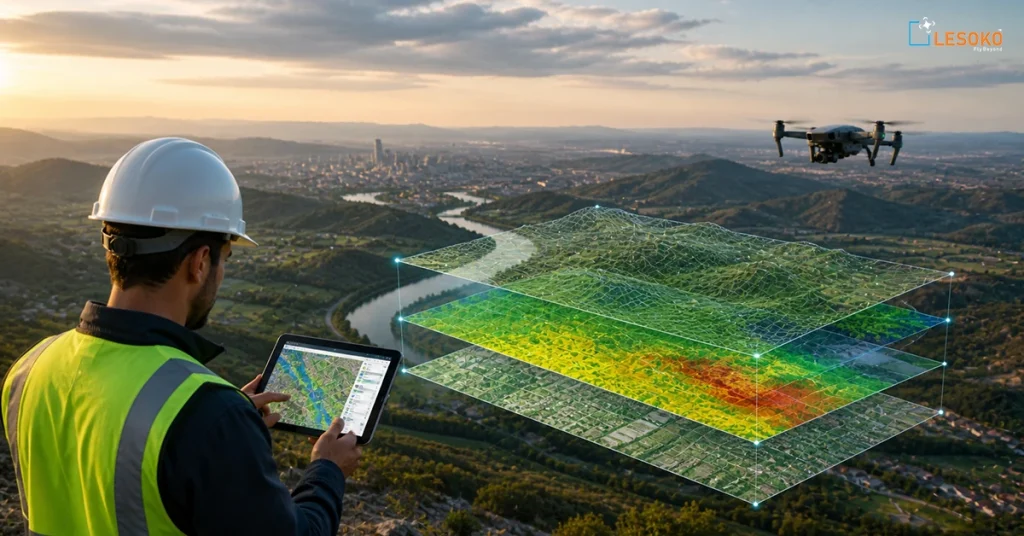
Many clients ask us what it actually looks like to work with a drone geospatial team. Here is the step-by-step process for a typical solar inspection engagement.
- Scoping call (Day 1): You share site coordinates, MW capacity, and report requirements. We confirm sensor type, team size, and timeline.
- Regulatory clearance (Day 2-3): Our team files Digital Sky Platform clearance, obtains any required ATC NOC, and confirms site access logistics.
- Mobilization (Day 4): Equipment and crew dispatched from nearest Lesoko state hub. Most locations in India are within 12 hours of a Lesoko team.
- Flight operations (Day 5 onwards): Systematic drone coverage of entire plant at 50-60 m altitude. Each MW takes approximately 60-80 minutes of flight time.
- Data processing (same day): Raw thermal and RGB imagery processed in-house using Pix4D and proprietary defect classification software.
- Report delivery (72 hours from last flight): IEC 62446-3 PDF report, geo-tagged defect map (KML), panel-level severity classification, and string-level recommendations.
- Technical debrief (optional): 60-minute call with our technical team to walk through findings and prioritize maintenance actions.
FAQ: Geospatial Solutions in India
What are geospatial solutions and how are they used in India?
Geospatial solutions are services that collect and analyze data linked to physical locations on Earth using drones, LiDAR, GIS software, GPS, and satellites. In India, they are used for land surveys, solar plant inspection, transmission line monitoring, smart city mapping, crop health analysis, and infrastructure project management. They replace slow, expensive manual processes with faster, more accurate digital data.
Is drone inspection better than manual inspection for solar plants?
Yes, in almost every measurable way. Drone inspection covers 5–10 MW per day versus 0.3–0.5 MW for a manual thermography team. It eliminates safety risks associated with working on energized panels. It provides 100% area coverage. And it produces a standardized, geo-tagged report compliant with IEC 62446-3. Manual inspection’s only remaining advantage is in situations where physical access to specific equipment is required.
What is LiDAR survey and when should I use it?
LiDAR (Light Detection and Ranging) fires laser pulses to measure precise distances, creating a 3D point cloud of terrain and structures. Unlike drone photogrammetry, LiDAR can measure ground elevation beneath tree canopy. Use LiDAR when you need ground-level terrain data in forested areas, accurate 3D models of structures (towers, bridges), catenary sag measurements for transmission lines, or volume calculations in open-pit mining. For open terrain without vegetation, drone photogrammetry is often faster and less expensive.
What DGCA approvals are required for commercial drone surveys in India?
For commercial drone operations in India, you need: (1) A DGCA-registered drone with a valid Unique Identification Number (UIN). (2) An operator with a DGCA-certified Remote Pilot Licence (RPL). (3) Pre-mission clearance via the Digital Sky Platform. Automatic for most Green Zone operations below 400 ft AGL. (4) ATC No-Objection Certificate for flights within 5 km of airports or controlled airspace. Lesoko manages all regulatory compliance as part of every project, including filing clearances and coordinating with local authorities.
What data formats are delivered after a drone survey or inspection?
Standard deliverables from a Lesoko geospatial project include: GeoTIFF orthophoto (high-resolution georeferenced aerial image), DEM/DSM (digital elevation and surface models), KML/KMZ files (for Google Earth and GIS platforms), SHP Shapefile (for ArcGIS and QGIS), LAS/LAZ point cloud (for LiDAR projects), and PDF inspection reports with geo-tagged defect overlays. All deliverables are compatible with major BIM, GIS, and project management platforms used by Indian EPC and infrastructure companies.
Which industries in India benefit most from geospatial solutions?
The top industries using geospatial solutions in India today are: solar energy (O&M inspection and project development), road and highway infrastructure (surveying and progress monitoring), power transmission (line inspection and corridor mapping), construction (volumetric tracking and milestone verification), agriculture (crop health and precision farming), urban planning and smart cities (property mapping and GIS integration), and mining (volume calculation and safety compliance). The common thread is any industry where knowing the precise state of a large physical asset affects profitability or safety.
How accurate is drone survey data compared to traditional ground survey?
A professional drone survey using RTK GNSS achieves horizontal accuracy of 2–5 cm and vertical accuracy of 3–7 cm. Comparable to or better than traditional total-station ground surveys in most applications. The advantage of drone surveys is that they cover large areas consistently, without the accumulation of human measurement errors over long distances. For boundary surveys requiring legal accuracy at the plot level, a hybrid approach. Drone photogrammetry for area coverage plus RTK ground control points for boundary accuracy.
The Competitive Advantage Is Measured in Days and Crores
Geospatial solutions are not a future technology. They are a present-day operational advantage that Indian infrastructure and energy companies are either capturing — or conceding to competitors who are.
The solar developer who inspects 250 MW in 9 days instead of 45 catches faults six weeks earlier, recovers lost generation faster, and presents better O&M data to lenders and investors. The highway contractor who produces drone-validated earthwork volumes reduces billing disputes and finishes on time. The state utility that does annual LiDAR corridor surveys cuts unplanned outages and regulatory penalties.
None of this requires a large capital investment. Geospatial solutions in India are now available as a service. Project by project, with fixed deliverables, guaranteed timelines, and clear pricing.
The only question is whether you move first, or watch your competitors do it.