
Aerial Mapping India: How Drone Surveys Are Replacing Ground Teams Across Industries
Table of Contents
India added over 18 GW of solar capacity in a single year, approved hundreds of kilometres of new railway corridors, and pushed multiple large-scale mining expansions all of which demand precise, up-to-date site data before a single foundation is poured or panel is mounted. Traditional ground surveys struggle to keep pace. A conventional topographic survey of a 500-acre greenfield site can take three to four weeks and still return positional errors of half a metre or more.
Aerial mapping India has changed that calculus entirely. Drone-based survey platforms now cover the same 500 acres in a single day, producing orthomosaic maps accurate to 2–3 centimetres and 3D terrain models that feed directly into EPC design workflows.
You will learn what aerial mapping India actually involves, which industries are adopting it fastest in India, what deliverables to expect, how regulations work under the DGCA framework, and what it genuinely costs. So you can make an informed decision for your next project.
What Is Aerial Mapping and Why Does It Matter for Industrial Projects in India?
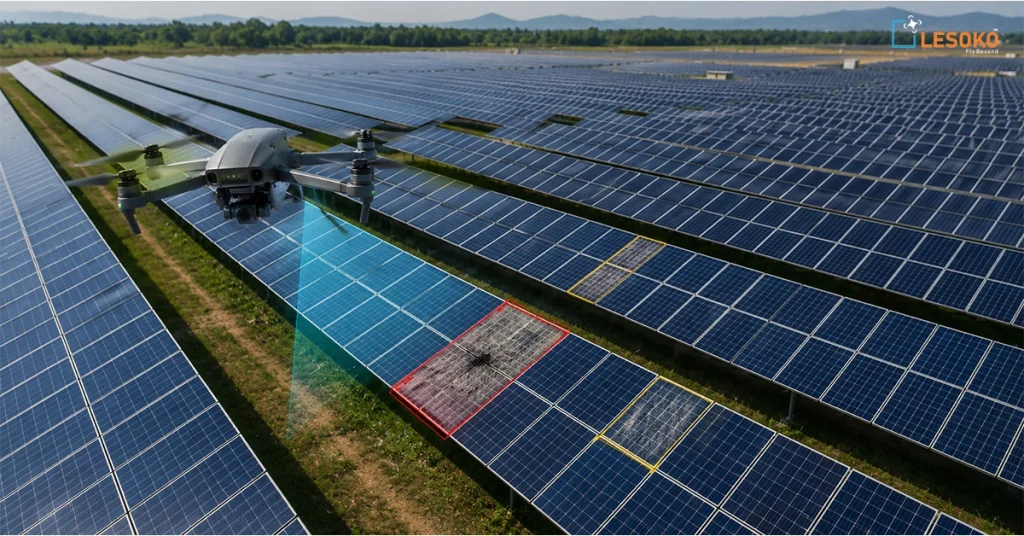
Aerial mapping is the process of collecting georeferenced imagery and sensor data from an airborne platform in modern industrial practice, that almost always means a UAV and processing it into actionable geospatial deliverables: orthomosaic maps, digital elevation models (DEMs), LiDAR point clouds, or volumetric stockpile reports.
The distinction from satellite imagery is resolution and timeliness. Commercial satellite passes deliver imagery at 30–50 cm resolution on a revisit cycle measured in days. A drone survey over the same site delivers 2–5 cm ground sampling distance on demand, with data processed and delivered within 24–48 hours.
For India’s industrial sectors, this gap matters enormously. A 100 MW solar IPP performing a pre-construction survey needs to know exact terrain elevations to within centimetres not just approximate contours to model drainage, calculate earthwork volumes, and design mounting structures. A mining company calculating quarterly royalty payables on extracted ore needs volumetric data that will withstand audit scrutiny.
The photogrammetry method capturing overlapping aerial photographs and reconstructing 3D geometry through software drives most industrial drone mapping in India today. LiDAR (Light Detection and Ranging) is used when the terrain is heavily vegetated or when sub-canopy features need to be captured, such as in forested corridor surveys for power transmission lines.
DGCA drone regulations have created a formal licensing structure for commercial operations in India since 2021, with the Digital Sky Platform serving as the centralised permitting system. Operators holding DGCA-issued Remote Pilot Certificates can conduct commercial surveys legally across most of India’s airspace, subject to mission-specific approvals for controlled zones.
How Aerial Drone Mapping Works in Practice: From Site to Deliverable
A drone mapping mission follows a defined workflow. Understanding each stage helps project managers set realistic timelines and evaluate vendor proposals accurately.
1. Mission planning
The survey team defines the area of interest, sets the required ground sampling distance (GSD), and calculates the flight plan: altitude, overlap percentages (typically 80% front-overlap, 70% side-overlap for photogrammetry), and the number of batteries or flight legs required. A 200-acre site at 3 cm GSD typically requires two to three flight sorties.
2. Ground control point placement
Ground control points (GCPs) physical markers with known GPS coordinates measured by RTK GPS are distributed across the site before flying. GCPs are what convert drone imagery from relative geometry into absolute, surveyor-grade accuracy. Without GCPs or an onboard RTK-capable drone, positional accuracy degrades to 3–5 metres — unusable for most industrial applications.
3. Data acquisition and processing
The drone flies the planned route autonomously, capturing thousands of overlapping images. These are processed in photogrammetry software to produce the final deliverables: an orthomosaic map (a georeferenced, distortion-corrected aerial photograph mosaic), a digital elevation model, and if required a 3D point cloud.
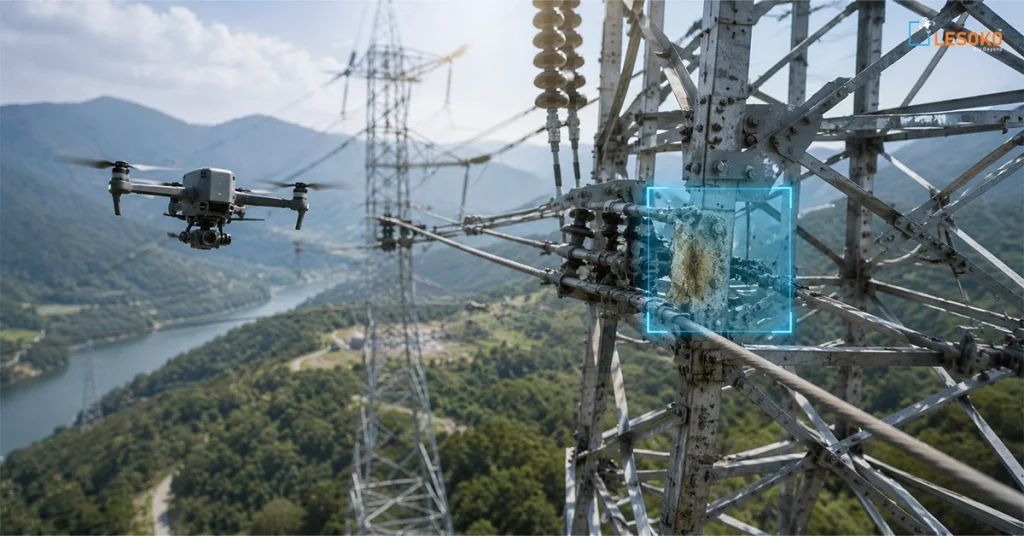
LiDAR point cloud output follows a similar workflow but uses time-of-flight laser pulses instead of camera images, making it the preferred method for corridor mapping of railway lines and power transmission routes through dense vegetation in states like Jharkhand and Odisha.
4. Delivery and integration
Processed outputs are delivered in standard GIS formats. GeoTIFF, LAS, DXF that integrate directly into AutoCAD, ArcGIS, and most EPC design platforms. Turnaround from site completion to delivered data is typically 24–72 hours.
If you are planning a pre-construction survey, asset inspection, or corridor mapping project and need data you can actually build from, Lesoko’s DGCA-certified pilots operate across India with sub-3 cm accuracy as standard. Talk to a Lesoko drone survey specialist about your project → lesoko.in
Key Benefits and Real-World Impact Across Indian Industries
The case for aerial drone mapping over ground survey is quantitative, not philosophical. Across Indian industrial projects, the operational differences are consistent enough to benchmark.
Speed: A topographic survey of a 300-acre site that takes a ground team 10–12 days takes a drone crew one day of flying and two days of processing. For EPC contractors managing tight COD timelines, this compression is material.
Cost: Drone survey vs ground survey cost in India typically favours aerial mapping by 40–60% on sites above 50 acres, once you account for labour, equipment mobilisation, and the time cost of delayed data.
Access: Solar plants in Rajasthan and Gujarat, wind farms on the Tamil Nadu coast, and mining sites in Jharkhand often involve terrain that is inaccessible to ground teams without significant additional cost. Drones are indifferent to this.
Accuracy: With GCPs and RTK GPS, drone surveys regularly achieve 2–3 cm horizontal accuracy and 3–5 cm vertical accuracy. This meets or exceeds the specifications required for most civil engineering applications in India.
In the renewable energy sector specifically, drone mapping solar farms has moved from experimental to standard practice. Large IPPs operating multi-site portfolios across Rajasthan and Tamil Nadu now use aerial mapping as the baseline survey method for both greenfield development and annual asset validation avoiding the cost and delay of re-mobilising ground survey crews each cycle.
For mining operations, volumetric survey of stockpiles using drone-derived DEMs has reduced royalty calculation disputes a persistent operational friction in Jharkhand and Odisha because the data is defensible, timestamped, and reproducible.
Challenges and What to Watch Out For Before You Commission a Survey
Aerial mapping India is not a plug-and-play service. Several factors regularly cause projects to underdeliver, and most are avoidable with the right pre-mission discipline.
Regulatory clearances: Flying near airports, defence establishments, or state borders requires specific permissions through the Digital Sky Platform that can add days to the mobilisation timeline. Any vendor who does not raise this in the initial scoping call is one you should question.
GCP quality: The accuracy of the final deliverable is only as good as the GCP survey. Vendors who skip GCPs or use uncalibrated GPS receivers will produce visually convincing but positionally inaccurate data. Always ask for the GCP survey report.
Wind and weather: Sites in Tamil Nadu and coastal Andhra Pradesh can experience sustained winds above 15 m/s that ground certain drone platforms. A competent operator will have platform options suited to the local wind regime.
A question that comes up regularly: do you need DGCA approval for commercial drone mapping in India? Yes, for any commercial operation you need a licensed Remote Pilot, and for specific zones near airports, military areas, or international borders you need mission-specific clearance through Digital Sky. Most open-area industrial sites in non-restricted zones do not require prior permission beyond the operator’s existing DGCA certification.
Finally, clarify deliverable formats before sign-off. GeoTIFF, LAS, and DXF are industry standard. If a vendor proposes to deliver only screenshots or PDF maps, the data cannot be used in design software and you will pay twice.
Frequently Asked Questions
What is aerial mapping and how is it done?
Aerial mapping is the collection of georeferenced imagery or sensor data from an airborne platform typically a drone and the processing of that data into surveyor-grade geospatial outputs such as orthomosaic maps, digital elevation models, and point clouds. The process involves mission planning, ground control point placement for accuracy, autonomous flight data capture, and photogrammetry or LiDAR processing to produce the final deliverables.
What are the uses of drone mapping in India?
In India, industrial drone mapping is used across six primary sectors: pre-construction topographic surveys for solar and wind plants; volumetric stockpile measurement in open-cast mining; corridor surveys for railway and power transmission line projects; infrastructure progress monitoring for roads and ports; asset mapping for power distribution utilities; and periodic terrain validation for operating renewable energy sites.
Is drone survey legal in India?
Yes. Commercial drone survey operations are legal in India under the Drone Rules, 2021 administered by the DGCA. Operators must hold a valid Remote Pilot Certificate and operate DGCA-type-certified drones. Missions in controlled airspace, near airports, or close to sensitive installations require prior approval through the Digital Sky Platform. Most open-area industrial sites in green zones operate under the existing operator certification.
How accurate is drone aerial mapping India?
With properly placed ground control points surveyed by RTK GPS, drone photogrammetry achieves 2–3 cm horizontal accuracy and 3–5 cm vertical accuracy. LiDAR drone surveys in dense vegetation achieve similar horizontal accuracy with vertical accuracy of 5–10 cm depending on point density and canopy conditions. Both methods meet the accuracy requirements for civil engineering and EPC design applications.
What is the difference between LiDAR and photogrammetry?
Photogrammetry reconstructs 3D geometry from overlapping optical photographs and is suited to open terrain, solar sites, and mining. LiDAR fires laser pulses and measures return times to build point clouds, making it effective under vegetation cover and for corridor mapping where ground surface must be captured beneath a tree canopy. Photogrammetry is typically lower cost; LiDAR is preferred when canopy penetration is required.
What deliverables are produced in a drone mapping survey?
A standard drone mapping survey produces: an orthomosaic map (georeferenced aerial image mosaic in GeoTIFF format), a digital surface or terrain model (DSM/DTM in GeoTIFF or ASCII grid format), a contour map, and optionally a 3D point cloud in LAS format. Volumetric reports, cut-and-fill calculations, and AutoCAD-compatible DXF outputs are produced as secondary deliverables for civil and mining applications.
How long does a drone aerial survey take?
For a 100-acre site, a single drone crew completes the flying in three to five hours. A 500-acre site requires one full flying day with multiple sorties. Processing time after flying is 24–48 hours for standard photogrammetry deliverables, and 48–72 hours for LiDAR point cloud processing. Total timeline from mobilisation to delivered data is typically two to four days for most industrial sites.
Aerial mapping in India has crossed the threshold from specialist technology to standard project practice. For solar, wind, mining, railway, and infrastructure teams operating across the country, the operational and economic case is no longer theoretical. It is visible in project timelines, survey budgets, and the quality of data feeding into design.
The decision is not whether to use drone surveys, but which operator has the regulatory standing, equipment, and domain knowledge to deliver data you can build from. Lesoko operates across India with DGCA-certified pilots, sub-3 cm accuracy as standard, and experience across the sectors that matter.
Visit lesoko.in/drone-survey-services or talk directly to a Lesoko DGCA-certified drone survey specialist about your next project whether that is a greenfield solar site in Rajasthan, a mining corridor in Jharkhand, or a railway alignment in Tamil Nadu.