
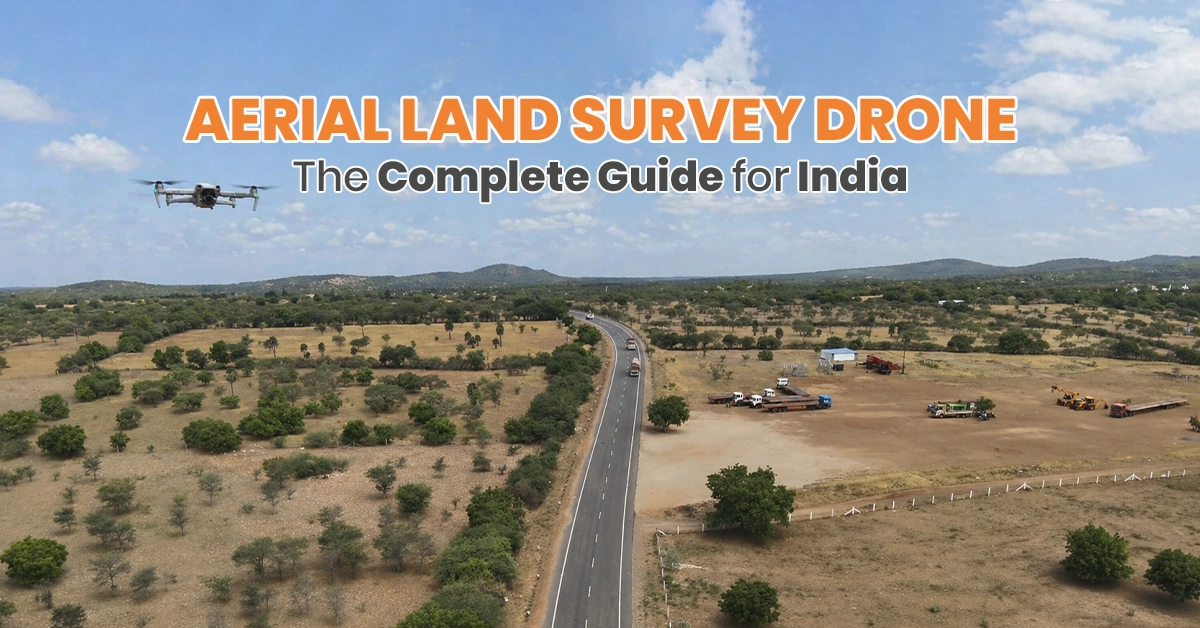
India’s infrastructure boom is rewriting the rules of land surveying and aerial drones are the new standard-bearers.
If you’ve ever watched a construction project stall for weeks because the survey report wasn’t ready, or seen a solar farm proposal get rejected due to inaccurate land data, you already understand the cost of slow, outdated surveying methods.
An aerial land survey drone solves that problem fast, accurately, and at a fraction of traditional costs. Whether you’re a civil engineer, real estate developer, government official, or farmer trying to understand your land better, this guide gives you everything you need to know about drone-based land surveys in the Indian context.
We’ll cover how it works, what it costs, where it’s being used right now across India, and how you can use it to make smarter, faster decisions.
Table of Contents
What Is an Aerial Land Survey Drone?
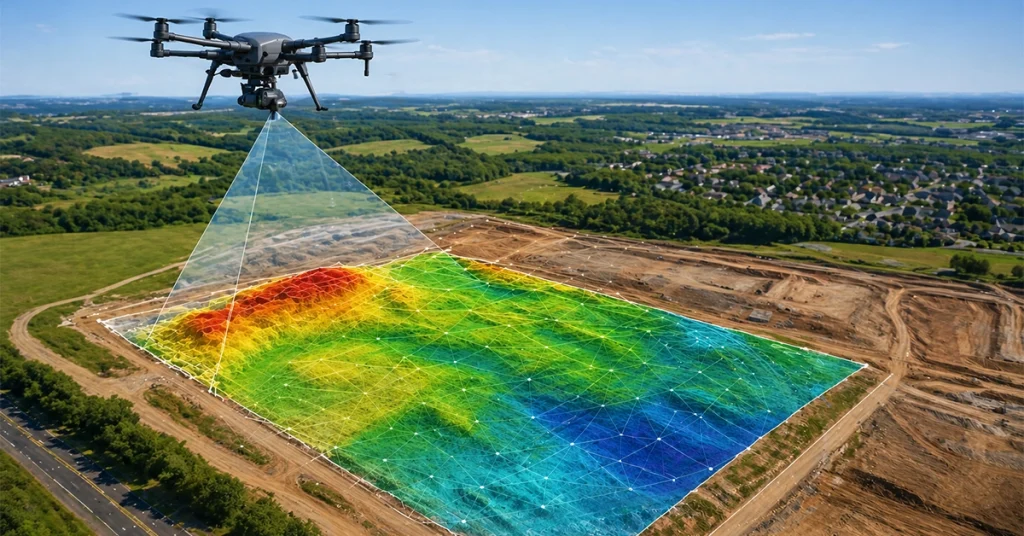
An aerial land survey drone also called a UAV (Unmanned Aerial Vehicle) survey system is a remotely piloted aircraft equipped with high-resolution cameras, GPS modules, LiDAR sensors, or multispectral payloads. It flies over a defined area, captures overlapping images or point-cloud data, and software processes that raw input into precise 2D maps, 3D models, or elevation data.
Think of it as a flying surveyor’s instrument that can cover 100 hectares in a single day. A feat that would take a traditional ground survey team two to three weeks.
Key Components of a Aerial Land Survey Drone
- Aircraft: UAV platform (fixed-wing or multirotor)
- Payload: RGB camera, LiDAR sensor, or multispectral payload
- GNSS Module: RTK/PPK GPS for centimetre-level geo-referencing
- Software: Mission planning software (DJI Terra, Pix4D, DroneDeploy)
- GCPs: Ground Control Points (GCPs) for additional accuracy
- Processing: Photogrammetry or point-cloud processing platform
How Does a Drone Land Survey Work? (Step-by-Step)
Understanding the workflow demystifies the technology and helps you set realistic expectations for your project.
- Site reconnaissance and mission planning — the pilot defines flight boundaries, altitude, and overlap percentage using mission planning software.
- GCP placement — physical markers are placed at known coordinates across the survey area to anchor spatial accuracy.
- Autonomous drone flight — the UAV follows a pre-programmed grid pattern, typically at 60–120 m AGL (Above Ground Level), capturing images every few seconds.
- Raw data collection — hundreds or thousands of geotagged images (or LiDAR point clouds) are recorded on-board.
- Photogrammetric processing — software like Pix4Dmapper or Agisoft Metashape stitches images into an orthomosaic, DSM (Digital Surface Model), and 3D point cloud.
- Deliverable generation — final outputs include GIS-ready files (.tif, .shp, .dxf), volume reports, contour maps, and cross-section profiles.
- QA and delivery — results are verified against ground truth measurements and delivered to the client.
Pro Insight: For large linear projects like highways or pipelines, fixed-wing drones (e.g., senseFly eBee or WingtraOne) cover 500+ hectares per day vs 50–80 ha for multirotor platforms. Choosing the right drone type is as important as the survey itself.
Accuracy: How Precise Is Aerial Land Survey Drone Data?
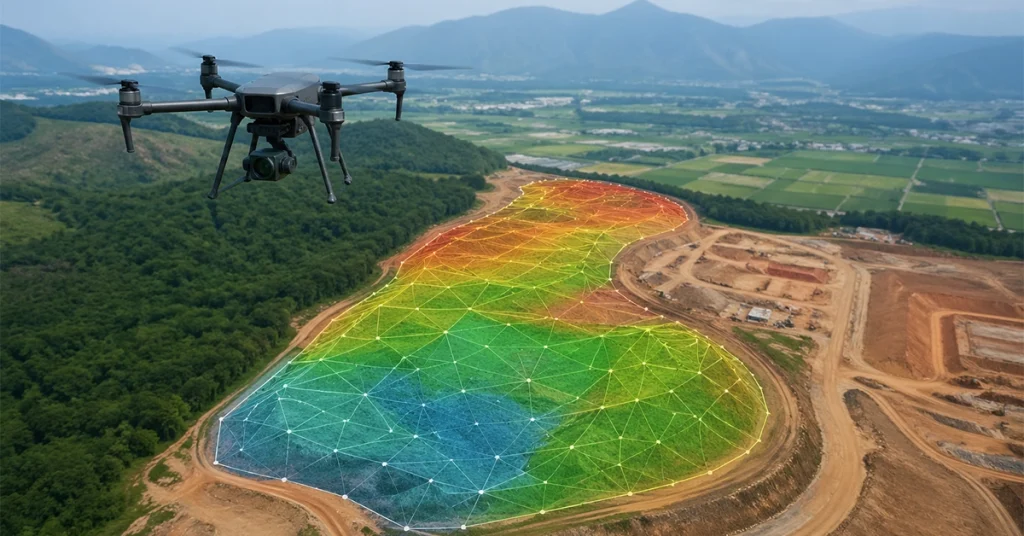
This is the question every project manager asks first. The short answer: Modern aerial land survey drones routinely achieve 2–5 cm horizontal accuracy and 3–10 cm vertical accuracy with proper GCP placement. Comparable to or better than traditional total station surveys for most applications.
Factors That Affect Accuracy
- Flying altitude: lower altitude means higher resolution and better accuracy
- GCP density and distribution: more GCPs = better spatial anchoring
- RTK vs PPK GPS: RTK provides real-time correction; PPK offers post-flight correction without live data link
- Overlap percentage: 80% frontal and 70% side overlap is standard for survey-grade work
- Terrain type: flat open areas perform better than dense vegetation or complex urban environments
- Camera quality: Sony full-frame sensors produce 3 cm GSD at 100 m altitude
For cadastral surveys, legal boundary demarcation, and infrastructure projects in India, drone data at 2–5 cm accuracy is now accepted by many state governments and agencies like NRSC (National Remote Sensing Centre).
Drone Survey vs Traditional Methods: A Direct Comparison
Here’s how aerial drone survey stacks up against conventional land survey approaches in the Indian context:
| Method | Time Required | Accuracy | Cost (per Hectare) | Scalability |
| Traditional Survey | Days to Weeks | Moderate | Rs 800–2,000 | Low |
| Satellite Imagery | Days | Low–Moderate | Rs 300–900 | High |
| Aerial Drone Survey | Hours | Very High (2–5 cm) | Rs 200–600 | Very High |
| GPS Ground Survey | Days | High | Rs 1,500–3,000 | Low |
The data speaks for itself. Drone surveys are not just faster. They’re more economical at scale and deliver richer data outputs. A single drone flight captures topography, planimetry, and volumetrics simultaneously.
Top Use Cases for Aerial Land Survey Drones in India
1. Real Estate and Land Development
Developers across Maharashtra, Gujarat, and Karnataka are using drone surveys before acquiring land parcels. A drone survey of a 50-acre site in Pune can be completed in 4–5 hours and delivers:
- Accurate parcel boundaries and areas
- Elevation profiles for drainage and foundation planning
- 3D site models for investor presentations
- Encroachment detection on disputed plots
2. Mining and Quarry Volume Management
India’s mining sector from iron ore in Odisha to limestone in Rajasthan relies on accurate stockpile volume measurements. Traditional methods using total stations took days and were often 5–15% inaccurate. Drone surveys generate stockpile volumes in hours with 1–3% error margins.
3. Agriculture and Irrigation Planning
With over 140 million hectares of agricultural land in India, precision land mapping is critical for:
- Watershed and drainage analysis
- Irrigation channel planning and optimization
- Soil erosion monitoring
- Farm boundary demarcation for PM-KISAN and other government scheme eligibility
4. Solar Energy Project Development
This is an area where Lesoko has deep, hands-on expertise. Before installing a solar plant whether a 1 MW rooftop system or a 100 MW utility-scale farm detailed land surveys are non-negotiable. Drone surveys for solar projects deliver:
- Precise slope analysis to optimize panel tilt and row spacing
- Shadow obstruction mapping from trees, structures, and terrain
- Land ownership boundary verification
- Construction progress monitoring across the project lifecycle
- Thermal imaging integration for operational plant inspections
Case in Point: A 50 MW solar project in Rajasthan required topographic survey of 300 hectares. A traditional survey would have taken 3 weeks. Using a fixed-wing UAV with RTK GPS, the aerial survey was completed in 2 days, saving the developer Rs 4.8 lakh in survey costs alone and accelerating project timeline by 18 days.
5. Road and Highway Projects
NHAI and state PWDs are increasingly mandating drone surveys for corridor planning, cross-sectional analysis, and progress monitoring. Drone-derived DTMs (Digital Terrain Models) reduce design errors and cut project costs significantly.
6. Smart City and Urban Planning
From Amaravati to Dholera, smart city projects demand current, accurate base maps. Aerial drone surveys provide city planners with:
- High-resolution orthophoto base maps
- 3D city models for spatial analysis
- Change detection between multiple survey epochs
- Infrastructure asset inventories
7. Forest and Environmental Surveys
India’s Forest Survey of India (FSI) has piloted drone-based surveys for forest cover assessment. Multispectral drones classify tree species, estimate canopy density, and detect encroachments. Data that was previously available only from satellite imagery at far lower resolution.
Drone Land Survey Cost in India: What to Expect
One of the most common questions we get at Lesoko: ‘How much does a drone land survey cost in India?’ The honest answer is: it depends. But here’s a realistic breakdown:
Pricing Models
- Per-hectare rate: Rs 200–600/hectare for standard photogrammetry surveys
- Per-day rate: Rs 15,000–45,000/day depending on drone type and deliverables
- Project-based pricing: For large infrastructure projects, fixed-scope contracts offer better value
What Influences the Final Cost?
- Survey area size — larger areas reduce per-hectare cost
- Terrain complexity — hilly or forested terrain needs more flight time and GCPs
- Required accuracy — RTK/PPK and denser GCP networks add cost
- Deliverable type — basic orthomosaic vs full 3D model with volumetrics
- Location — remote sites with difficult access add mobilization costs
- DGCA compliance — regulatory approvals for restricted airspace add lead time
A100-hectare land survey with standard deliverables (orthomosaic + DSM + contour map) typically costs Rs 35,000–70,000 in India. Compared to Rs 1.5–3 lakh for equivalent traditional survey work.
DGCA Regulations: Flying Drones Legally in India
India’s drone regulations have matured significantly. The Drone Rules 2021 and the Drone Airspace Map (DroneYantra / Digital Sky platform) govern all commercial UAV operations. Here’s what matters for aerial land surveys:
Key Regulatory Requirements
- UAS type certificate for drones above 250g
- Unique Identification Number (UIN) for the drone
- Remote Pilot Certificate (RPC) for the operator issued after DGCA-approved training
- Permission via Digital Sky platform for each flight in controlled or restricted airspace
- No-fly zones include airports (5 km radius), defence establishments, and international borders
Green Zone Operations
Most rural and semi-urban survey areas in India fall under the Green Zone which means flights up to 400 feet AGL can be conducted without prior permission, significantly streamlining project timelines for the majority of survey work.
Important: Always verify airspace on the Digital Sky portal before every mission. Airspace classifications can change, and flying in restricted zones carries heavy penalties including equipment seizure.
Choosing the Right Aerial Land Survey Drone: Fixed-Wing vs Multirotor
Not all drones are equal for land survey work. The right platform depends on your project scope, terrain, and deliverable requirements.
Multirotor Drones (DJI Phantom 4 RTK, Matrice 300 RTK)
- Best for: Small to medium areas (up to 200 ha), urban areas, detailed mapping
- Coverage: 50–100 ha per flight
- Accuracy: 1–3 cm with RTK
- Strength: Hover capability, vertical takeoff, works in tight spaces
- Limitation: Short battery life (25–40 min)
Fixed-Wing Drones (senseFly eBee X, WingtraOne)
- Best for: Large infrastructure corridors, agricultural surveys, 500+ ha projects
- Coverage: 300–500+ ha per flight
- Accuracy: 3–5 cm with PPK
- Strength: Long endurance (45–90 min), covers vast areas efficiently
- Limitation: Requires open launch area, no hover capability
LiDAR-Equipped Drones (DJI Zenmuse L1/L2)
- Best for: Dense vegetation, complex terrain, forest surveys
- Strength: Penetrates canopy, works in low-light, produces true DTM beneath vegetation
- Cost: Higher than photogrammetry, justified for forestry and infrastructure in vegetated areas
Data Deliverables: What You Get from a Drone Land Survey
A professional aerial land survey drone mission produces far more than just aerial photographs. Here’s the full spectrum of deliverables:
- Orthomosaic Map: stitched, georeferenced aerial image corrected for lens distortion and elevation. Accuracy: 2–5 cm/pixel GSD
- Digital Surface Model (DSM): elevation model including all surface features (buildings, trees, terrain)
- Digital Terrain Model (DTM): bare-earth elevation model with vegetation and structures removed
- Contour Maps: Topographic contours at 0.25 m, 0.5 m, or 1 m intervals
- 3D Point Cloud: Millions of georeferenced points for volumetric analysis and structural assessment
- 3D Mesh Model: photorealistic textured 3D model for visualization and planning
- Volume Reports: stockpile measurements for mining, earthwork, and construction
- Cross-Section Profiles for road, canal, and pipeline design
- GIS-Ready Files: .shp, .geotiff, .dxf, .kml formats compatible with AutoCAD, ArcGIS, QGIS
Why Choose Lesoko for Aerial Land Survey in India?
Lesoko operates PAN-India drone inspection and survey services with a proven track record across real estate, solar energy, infrastructure, mining, and agriculture sectors. Here’s what sets us apart:
- DGCA-certified pilots and NPNT-compliant operations across all Indian states
- Fleet of survey-grade drones including DJI Phantom 4 RTK, Matrice 300 RTK, and LiDAR-capable platforms
- In-house photogrammetry processing using Pix4D and Agisoft Metashape
- Deep domain expertise in solar energy surveys from feasibility to O&M inspection
- Typical turnaround: 24–72 hours from flight to final deliverables
- Transparent pricing no hidden mobilisation charges
- Dedicated project manager for every engagement
Lesoko has completed aerial surveys for solar developers, NHAI corridor assessments, mining volume audits, and smart city projects across Maharashtra, Gujarat, Rajasthan, Tamil Nadu, and Telangana.
Frequently Asked Questions (FAQs)
Q: How accurate is a drone land survey compared to a traditional survey?
A: With RTK GPS and proper GCPs, aerial drone surveys achieve 2–5 cm horizontal and 3–8 cm vertical accuracy. Comparable to or better than many traditional total-station surveys. For cadastral or legal demarcation purposes, check your state surveying authority’s acceptance criteria.
Q: How long does a drone land survey take in India?
A: Flight time depends on area and drone type. A 100-hectare site can be flown in 2–4 hours with a multirotor. Processing and delivering final maps typically takes 24–72 hours. Compare this to 2–4 weeks for equivalent traditional survey work.
Q: What is the cost of a drone land survey per hectare in India?
A: Standard drone surveys cost approximately Rs 200–600 per hectare depending on terrain complexity, accuracy requirements, and deliverable scope. Detailed 3D modelling or LiDAR surveys cost more. Contact Lesoko for a project-specific quote.
Q: Is drone surveying legally accepted in India for property demarcation?
A: Several states, including Telangana (Dharani portal), Maharashtra (MAHABHUMI), and Gujarat, are integrating drone survey data into land records. NRSC and the Survey of India have also published drone survey guidelines. Always verify acceptance with the relevant state authority for legal boundary work.
Q: Do I need DGCA permission for every drone survey?
A: In Green Zones (most rural and semi-urban areas), flights up to 400 feet AGL do not require prior permission. Yellow and Red zones require permission via the Digital Sky platform. Your drone service provider should handle all DGCA compliance.
Q: What drone is best for large-area land surveys in India?
A: For areas above 200 hectares, fixed-wing platforms like the WingtraOne or senseFly eBee X are most efficient, covering 400–500 ha per flight. For smaller, complex sites, the DJI Phantom 4 RTK or Matrice 300 RTK with RGB or LiDAR payloads is ideal.
Q: Can drone surveys be used for solar farm site assessment?
A: Absolutely. Drone surveys are now standard practice for solar project site assessment in India. They provide slope analysis, shadow mapping, land boundary verification, and volumetric earthwork estimates. All critical inputs for solar plant design and DPR preparation.
Q: What file formats are delivered after a drone land survey?
A: Standard deliverables include GeoTIFF orthomosaics, LAS/LAZ point clouds, AutoCAD DXF contour files, Shapefiles (.shp), and PDF/Excel reports for volumes and cross-sections. Most are directly compatible with ArcGIS, QGIS, AutoCAD Civil 3D, and Bentley MicroStation.
The Future of Land Survey Is Already Here
The aerial land survey drone isn’t a futuristic technology anymore. It’s the pragmatic choice for anyone who needs accurate, fast, and cost-efficient land data in India today. From a 5-acre real estate plot in Pune to a 3,000-hectare mining lease in Chhattisgarh, drone surveys are compressing timelines from weeks to hours, reducing costs by 50–70%, and delivering data richness that traditional methods simply cannot match.
As India accelerates infrastructure development under schemes like PM Gati Shakti, PMAY, and the National Solar Mission, drone-based land surveys will only become more central to how we plan, build, and manage land.
The question isn’t whether to adopt aerial survey drones — it’s who you partner with to do it right.