
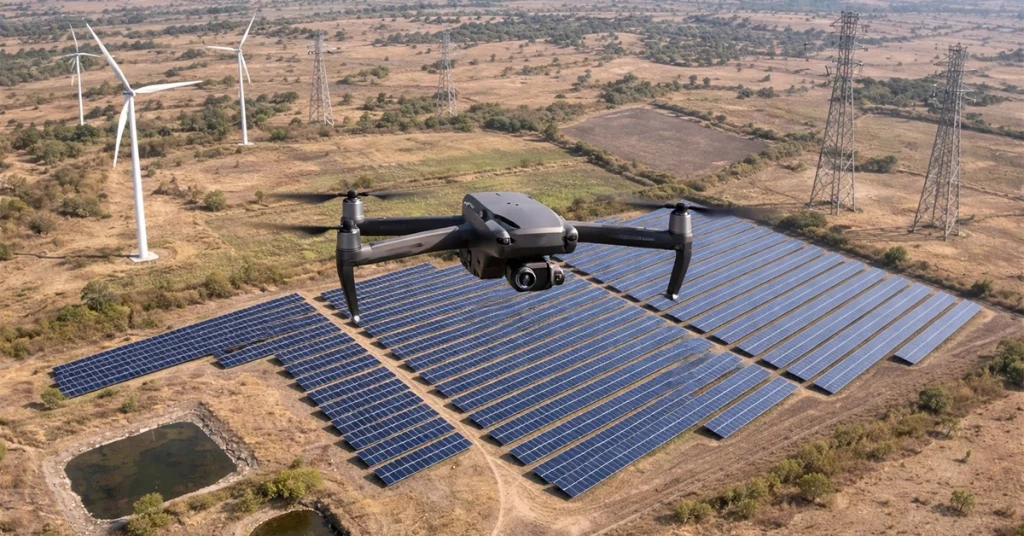
A large solar power plant near Tirunelveli has been underperforming for three months. Engineers suspect panel degradation but manually inspecting 15,000 panels across 50 acres would take two weeks and cost lakhs in labour. A DGCA-certified drone with a thermal camera completes the same inspection in four hours — identifying 230 underperforming panels with pinpoint accuracy, at a fraction of the cost.
This isn’t a future scenario. It’s happening right now across Tamil Nadu, and Chennai is quickly becoming one of India’s most active hubs for professional drone services.
Whether you manage infrastructure, oversee energy assets, or run a construction company, this guide will tell you everything you need to know about drone services in Chennai — from how they work and what they cost, to which provider can actually deliver results at scale.
Table of Contents
What Are Drone Services and Why Do They Matter in India?
Drone services — or UAV (Unmanned Aerial Vehicle) services — refer to professional operations that deploy remotely piloted aircraft for inspection, surveying, mapping, thermography, and monitoring purposes. In the industrial context, this means using drones as precision tools to inspect assets that are expensive, dangerous, or time-consuming to access manually.
India’s infrastructure push under programs like PM Gati Shakti, the National Solar Mission, and smart city projects has created an enormous demand for rapid, accurate asset monitoring. Tamil Nadu alone has over 15 GW of renewable energy capacity, thousands of kilometres of transmission lines, and a rapidly expanding construction sector — all of which require regular, reliable inspection.
Traditional methods — rope access, scaffolding, cherry pickers — are slow, risky, and increasingly expensive. Drone-based inspection solves all three problems simultaneously. That’s why adoption is accelerating not just in Chennai, but across Mumbai, Ahmedabad, Hyderabad, and Pune as well.
How Industrial Drone Inspection Works (Step-by-Step)
Understanding the process helps you evaluate providers and set realistic expectations.
Step 1 — Site Assessment and Flight Planning Before any drone takes off, the inspection team analyses your asset’s geometry, identifies no-fly zones, reviews DGCA airspace permissions (via the Digital Sky Platform), and plans the flight path. For complex assets like cooling towers or transmission lines, this step is critical.
Step 2 — Regulatory Clearance All commercial drone operations in India require compliance with DGCA regulations. Operators must have Remote Pilot Licences (RPL), and drones above 250g must carry a valid UAS certificate. Reputable providers handle this entirely on your behalf.
Step 3 — Sensor Selection and Calibration Depending on the inspection objective, different sensors are deployed: RGB cameras for visual inspection, thermal (infrared) cameras for energy loss detection, LiDAR sensors for 3D mapping, or multispectral cameras for vegetation and solar analysis.
Step 4 — Data Capture The drone executes the planned flight, capturing thousands of high-resolution images or continuous video. For a typical industrial inspection, this phase takes between 2–8 hours depending on asset size.
Step 5 — Data Processing and Analysis Captured data is processed using photogrammetry software or AI-powered analytics platforms. Anomalies — like hot spots on solar panels, corrosion on steel structures, or cracks in concrete — are flagged and georeferenced.
Step 6 — Reporting and Recommendations You receive a structured inspection report with annotated images, GPS coordinates of defects, severity ratings, and recommended maintenance actions. A good report is actionable, not just descriptive.
Key Benefits: ROI, Safety, and Efficiency
The business case for drone inspection in India is no longer theoretical — it’s measurable.
Dramatically Reduced Inspection Costs
Manual inspection of a 132kV transmission tower requires scaffolding, a team of 4–6 technicians, safety equipment, and multiple site visits. A drone team can inspect the same tower in under 30 minutes. Across a network of 200 towers, the savings can exceed ₹20–40 lakhs per inspection cycle.
Zero Downtime, No Shutdowns
Unlike physical inspection, drone surveys typically require no operational shutdown. A running power plant, an operational telecom tower, an active construction site — all can be inspected without halting work.
Unmatched Safety Record
Working at height remains one of the leading causes of industrial fatalities in India. Drone inspection removes human workers from dangerous environments entirely. For oil and gas facilities, chemical plants, and offshore assets, this is non-negotiable.
Higher Detection Accuracy
Thermal cameras can detect temperature anomalies as small as 0.1°C — defects invisible to the naked eye. LiDAR can model structural deformations to millimetre precision. Human inspectors, no matter how skilled, simply cannot match this level of detail consistently.
Faster Turnaround
A drone survey that takes hours in the field can produce a complete, shareable digital report within 24–48 hours. For project managers working to tight deadlines, this matters enormously.
Drone Inspection Costs in India (2026 Estimates)
Cost is the most searched question for anyone evaluating drone services — and understandably so. Here’s a realistic breakdown:
| Service Type | Estimated Cost Range (India) |
|---|---|
| Solar panel thermography (per MW) | ₹8,000 – ₹20,000 |
| Transmission tower inspection (per tower) | ₹3,000 – ₹8,000 |
| Construction site progress monitoring | ₹15,000 – ₹40,000 per visit |
| Telecom tower inspection | ₹5,000 – ₹12,000 per tower |
| Industrial plant / chimney inspection | ₹25,000 – ₹75,000 |
| LiDAR / topographic survey (per km²) | ₹20,000 – ₹60,000 |
Important caveats: These are indicative ranges. Final pricing depends on asset complexity, location (urban vs. remote), regulatory clearance requirements, deliverable format, and the provider’s equipment tier. Always request itemised quotes and clarify what the report includes.
Providers offering suspiciously low pricing often cut corners on sensor quality, regulatory compliance, or data analysis — which defeats the purpose of the inspection entirely.
Use Cases Across Industries in Tamil Nadu and Beyond
Renewable Energy — Solar and Wind
Tamil Nadu is India’s second-largest solar energy state. Drone thermography is now standard practice for O&M teams managing utility-scale plants in Ramanathapuram, Thoothukudi, and Villupuram districts. Wind turbine blade inspection using drones has similarly taken off in Coimbatore and Tirunelveli.
Transmission and Distribution Infrastructure
TANGEDCO and private transmission companies operating across Tamil Nadu use UAV inspection to monitor high-voltage lines, substations, and insulator strings — particularly after monsoon season when fault rates spike.
Telecom Tower Inspection
With 5G rollout accelerating across Chennai, Coimbatore, and Madurai, tower inspection requirements have intensified. Drone-based inspections deliver faster turnaround than rope access and produce standardised, comparable data across large tower portfolios.
Construction and Real Estate
Large-scale construction projects in OMR Chennai, TIDEL Park expansions, and port developments in Ennore rely on drone surveys for volumetric calculations, progress documentation, and site mapping.
Oil, Gas, and Petrochemicals
Facilities in Chennai’s Manali industrial belt and refineries across Gujarat and Maharashtra use drone inspection for storage tank exteriors, flare stacks, and pipeline corridors — assets where manual access is hazardous.
Ports and Coastal Infrastructure
Chennai Port, one of India’s largest, is increasingly exploring drone-based inspection for jetty structures, warehouse rooftops, and vessel monitoring.
How to Choose the Right Drone Inspection Company in India
This is where most businesses make costly mistakes. Here’s what separates a reliable provider from a risky one.
1. DGCA Compliance — Non-Negotiable
Verify that the company’s pilots hold valid Remote Pilot Licences and that their drones are registered on the Digital Sky Platform. Ask for documentation upfront. Non-compliant operations expose you to legal liability.
2. Industry-Specific Experience
A company that mostly does wedding photography is not qualified to inspect a 400kV substation. Look for case studies, client references, and portfolios specific to your industry.
3. Sensor and Equipment Quality
Ask what cameras and sensors they deploy. Enterprise-grade thermal cameras (FLIR, DJI Zenmuse XT2) produce very different results than consumer-grade alternatives. Understand what you’re paying for.
4. Data Processing Capability
The drone flight is only 30% of the work. The remaining 70% is data analysis. Does the provider have in-house processing? Do they use AI-assisted anomaly detection? How are reports structured?
5. Scalability and Pan-India Reach
If you manage assets across multiple states, you need a provider with operational capacity beyond a single city. A Chennai-only operator cannot support your Gujarat refinery or your Rajasthan solar farm.
6. Insurance and Liability Coverage
Professional drone operators carry third-party liability insurance. Always confirm this before signing any contract.
Lesoko operates as a DGCA-compliant, Pan-India drone inspection company, with active deployments across Tamil Nadu, Maharashtra, Gujarat, and other major industrial states. For large-scale or multi-site inspection requirements, partnering with a provider that understands both the technical and regulatory landscape at a national level is worth the conversation.
Future Trends: What’s Coming Next in Drone Inspection
AI-Powered Anomaly Detection Machine learning models are being trained on millions of drone images to automatically classify defect types, severity levels, and degradation trends. This will reduce report turnaround time to near real-time.
BVLOS (Beyond Visual Line of Sight) Operations DGCA is progressively expanding BVLOS permissions for industrial operators. When fully operational, this will allow single operators to inspect transmission corridors spanning hundreds of kilometres in a single mission.
Drone-in-a-Box Automation Permanently deployed drones housed in weather-proof docking stations will enable scheduled, autonomous inspections without human intervention — ideal for remote solar plants and pipelines.
Digital Twin Integration Inspection data is increasingly being fed into digital twin platforms, enabling asset managers to track structural health over time and predict maintenance needs before failures occur.
FAQs About Drone Services in Chennai
Is drone inspection legal in India?
Yes. Commercial drone operations are legal and regulated by the DGCA under the Unmanned Aircraft System (UAS) Rules, 2021. Operators must obtain proper licensing and register drones on the Digital Sky Platform.
How much does drone inspection cost in India?
Costs vary widely by service type. Solar panel thermography starts around ₹8,000 per MW, while complex industrial inspections can cost ₹25,000–₹75,000 or more. Always request detailed quotes.
Do I need DGCA-approved pilots for my inspection project?
Yes. Any commercial drone operation in India must be conducted by pilots with a valid Remote Pilot Licence (RPL) issued by DGCA.
How accurate is drone-based thermal inspection?
High-quality thermal cameras can detect temperature anomalies with precision of 0.1°C or better, making them significantly more accurate than manual visual inspection for energy loss detection.
How long does a drone inspection take?
A solar plant of 5 MW can typically be inspected in 3–5 hours of flight time. Industrial structures like chimneys or cooling towers may take 2–4 hours. Final reports are usually delivered within 24–48 hours of data capture.
Can drones inspect active, operational assets?
In most cases, yes. Drone inspection rarely requires operational shutdown, which is one of its key advantages over traditional physical inspection methods.
What industries in Chennai use drone inspection services?
Energy (solar, wind, transmission), telecom, construction, petrochemicals, ports, and real estate are the primary users in Chennai and across Tamil Nadu.
Are drones used for solar panel inspection in India?
Absolutely. Drone thermography is now one of the most widely adopted O&M practices for solar plants across India, with Tamil Nadu, Rajasthan, and Gujarat being the most active markets.
What is the difference between a drone survey and a drone inspection?
A drone survey primarily collects spatial data (maps, 3D models, topographic data), while a drone inspection focuses on assessing the condition of a specific asset or structure. Many projects require both.
How do I hire a DGCA-certified drone company in Chennai?
Look for providers who can share RPL documentation, drone registration certificates, and operational experience in your specific industry. Companies like Lesoko offer transparent compliance documentation alongside their service proposals.