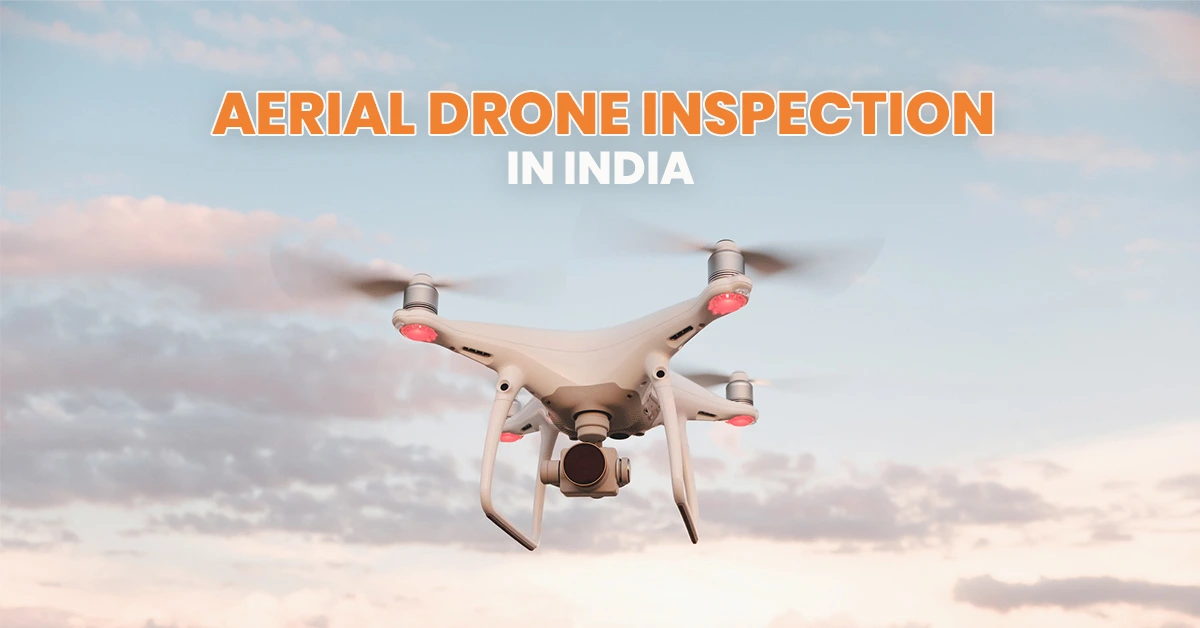
A 200-metre telecom tower in Rajasthan needs a structural inspection. Traditionally, that means weeks of planning, scaffolding, and putting trained workers at serious risk at height — all for a job that takes days and costs lakhs.
Now picture a drone completing that same inspection in under two hours, delivering 4K imagery and a detailed report the same evening — with zero risk to human life. This isn’t the future. This is happening right now across India, from the wind farms of Tamil Nadu to the oil refineries of Gujarat. Aerial drone inspection has quietly become one of the most powerful tools available to infrastructure, energy, and industrial operators — and Indian businesses are only beginning to tap its full potential.
Table of Contents
What Is Aerial Drone Inspection?
Aerial drone inspection is the use of unmanned aerial vehicles (UAVs) equipped with high-resolution cameras, thermal sensors, LiDAR, or gas detection payloads to inspect infrastructure, assets, and terrain — without requiring manual access.
In simple terms: instead of sending a person up a ladder, onto a roof, or into a confined space, you send a drone.
In India, this practice is regulated by the Directorate General of Civil Aviation (DGCA), which governs all commercial drone operations under the Drone Rules 2021. Any legitimate drone inspection company must operate with DGCA-certified pilots and registered UAVs — a non-negotiable compliance requirement.
How Does Aerial Drone Inspection Work?
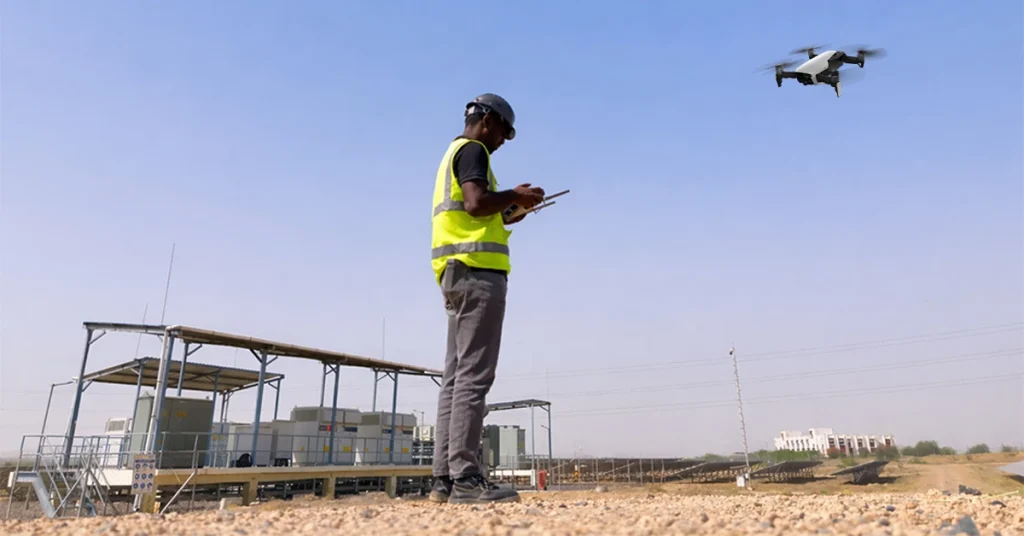
The process is more methodical than most people expect. Here’s a typical workflow:
1. Pre-Inspection Planning
The team studies the asset — be it a solar farm in Karnataka or a refinery in Vadodara — and plans flight paths, payload selection (thermal vs. RGB vs. LiDAR), and regulatory clearances.
2. Flight Operation
A DGCA-certified remote pilot operates the UAV, following a pre-programmed or manually controlled flight path. Modern drones can fly autonomously along GPS-mapped routes, ensuring complete, repeatable coverage.
3. Data Capture
Depending on the inspection type:
- RGB cameras capture high-resolution visual data for structural cracks, corrosion, and surface defects
- Thermal/infrared sensors detect heat anomalies in solar panels, electrical systems, or insulation failures
- LiDAR creates precise 3D point clouds for topographic surveys and volumetric analysis
- Gas sensors identify leaks in pipelines and chemical plants
4. Data Processing & Reporting
Raw imagery is processed using photogrammetry software or AI-based analysis tools. The client receives a structured report with annotated findings, severity ratings, and recommended actions — typically within 24–48 hours.
This end-to-end process replaces weeks of manual inspection with days — or sometimes hours.
Key Industries Using Drone Inspection in India
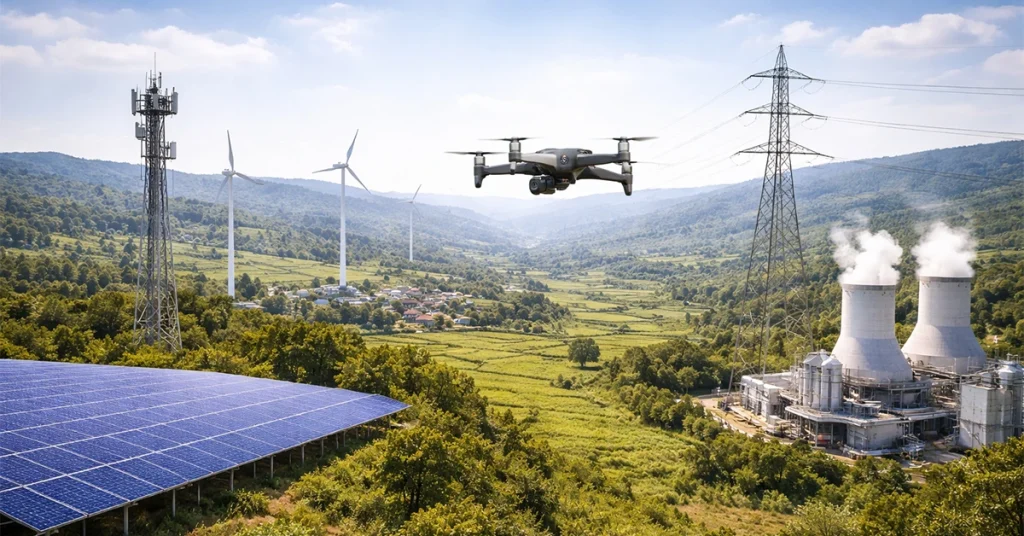
India’s infrastructure boom makes it one of the most active drone inspection markets in Asia. Here’s where UAV inspection is making the biggest impact:
Solar Energy
India has an installed solar capacity crossing 80 GW. Managing and maintaining solar parks across Rajasthan, Andhra Pradesh, and Maharashtra is a logistical challenge. Thermal drones identify underperforming panels, hotspots, and bypass diode failures — cutting maintenance costs significantly.
Infrastructure & Civil Engineering
From bridges in Pune to metro structures in Hyderabad, drone inspection is helping engineers detect cracks, spalling, and structural fatigue without closure or scaffolding.
Oil, Gas & Petrochemicals
Refineries and pipeline networks in Gujarat, Assam, and Odisha rely on regular corrosion and leak detection inspections. UAVs equipped with gas sensors and thermal cameras can survey kilometres of pipeline in a fraction of the time.
Telecom Towers
India has over 700,000 telecom towers. Manual tower climbing is dangerous and expensive. Drone inspection allows complete structural assessment of towers anywhere — from urban Delhi to remote Northeastern states — in minimal time.
Power Transmission Lines
Power utilities across India, including in Uttar Pradesh, Maharashtra, and Tamil Nadu, use UAVs to inspect high-tension transmission lines for conductor damage, insulator faults, and vegetation encroachment.
Industrial Facilities & Manufacturing Plants
Boilers, chimneys, tanks, and factory rooftops in industrial hubs like Pune, Chennai, and Ahmedabad can be assessed safely and thoroughly using drones.
Real Estate & Construction
Developers in cities like Bengaluru, Mumbai, and Gurugram use aerial imagery for site progress monitoring, marketing visuals, and regulatory documentation.
Top Benefits of Aerial Drone Inspection
✅ Safety First
Eliminating the need for workers at height or in confined spaces directly reduces accident risk. This is the single most compelling argument for drone inspection in industries like oil & gas, power, and telecom.
✅ Speed & Efficiency
A drone can cover in hours what would take a manual team days. A 1 MW solar plant inspection that once took 3–4 days now takes 4–6 hours.
✅ Lower Overall Cost
Despite the upfront cost, drone inspection delivers measurable ROI. Reduced labour, no scaffolding, shorter operational downtime, and earlier defect detection all contribute to long-term savings.
✅ Higher Data Quality
Modern UAVs capture data at resolutions and angles impossible for human inspectors. Thermal imaging, in particular, reveals anomalies invisible to the naked eye.
✅ Repeatable & Comparable
Because drones follow programmed flight paths, inspections are consistent. Data from different time periods can be overlaid and compared — enabling trend analysis and predictive maintenance.
✅ DGCA Compliant & Auditable
With proper documentation, drone inspection creates a defensible audit trail — valuable for insurance claims, regulatory compliance, and asset management.
How to Choose the Right Drone Inspection Company in India
With dozens of UAV companies entering the market, due diligence matters. Here’s what to evaluate:
1. DGCA Certification
Non-negotiable. Ensure the company operates with DGCA-licensed remote pilots and registered drones. Ask for documentation upfront.
2. Relevant Industry Experience
A company experienced in solar inspection may not be the right fit for a refinery. Look for sector-specific case studies and experience.
3. Payload & Technology Capability
Does the company have thermal cameras, LiDAR, or gas detection payloads relevant to your need? Generic drone operators and specialized inspection teams are very different.
4. Reporting Quality
Ask for a sample report. A good drone inspection company delivers structured, actionable reports — not just raw footage.
5. Insurance & Liability Coverage
Professional companies carry aviation-grade liability insurance. This protects both parties in the unlikely event of an incident.
6. Pan-India Operational Capability
If your assets are spread across multiple states, ensure the company can mobilize teams to locations like remote Odisha, hilly Uttarakhand, or island territories like the Andamans.
The Future of UAV Inspection in India
India’s drone ecosystem is evolving rapidly. Several trends are reshaping the industry:
- AI-Powered Defect Detection: Machine learning models are being trained on inspection imagery to automatically flag defects — reducing analyst time and improving consistency.
- BVLOS Operations: Beyond Visual Line of Sight clearances from DGCA will unlock longer-range inspections, especially for pipelines and transmission lines.
- Digital Twin Integration: Drone data is increasingly being used to build and update digital twins of infrastructure assets — enabling continuous remote monitoring.
- Drone-as-a-Service (DaaS): Companies are moving towards subscription-based inspection contracts, offering predictable costs and scheduled monitoring.
India’s National Drone Policy and the PLI scheme for drone manufacturing signal strong government intent — the sector is positioned for significant growth through 2030.
Why Choose Lesoko for Aerial Drone Inspection?
At Lesoko, we combine technical expertise, DGCA-compliant operations, and deep industry knowledge to deliver inspection services that genuinely move the needle for our clients.
Whether you manage solar assets in Rajasthan, telecom infrastructure in the Northeast, or industrial facilities in Maharashtra, our team brings the right payload, the right protocol, and the right reporting to every project.
We’ve worked across industries and geographies — and we understand that a drone inspection isn’t just about footage. It’s about actionable intelligence that helps you make better decisions, faster.
👉 Check our drone inspection services or get in touch with our team to discuss your specific requirements.
What is aerial drone inspection and how does it work?
Aerial drone inspection is the use of unmanned aerial vehicles (UAVs) equipped with cameras and sensors to inspect industrial assets, infrastructure, and structures remotely. A certified pilot deploys the drone along a pre-planned flight path, capturing high-resolution visual, thermal, or LiDAR data. That data is then processed using photogrammetry or AI-based software to generate detailed inspection reports, 3D models, and anomaly maps. In India, all commercial drone operations must comply with DGCA regulations and the Digital Sky Platform — ensuring safe, legal, and accurate inspections.
Is drone inspection legal in India? What is DGCA compliance?
Yes, drone inspection is fully legal in India when operated under the framework established by Drone Rules 2021, issued by the Directorate General of Civil Aviation (DGCA). Compliance requires drones to be registered on the Digital Sky Platform, pilots to hold a valid Remote Pilot Certificate (RPC), and operators to carry appropriate insurance. Non-compliant operations expose businesses to legal liability and can invalidate insurance claims. Always verify that your drone inspection company in India is DGCA-certified before engaging their services.
Which industries use aerial drone inspection services in India?
Aerial drone inspection is used across a wide range of industries in India. The energy sector — including solar farms in Rajasthan, Gujarat, and Tamil Nadu — uses thermal UAV surveys to detect panel faults. Telecom operators use drones for 5G tower assessments. Construction companies rely on drone surveys for progress monitoring and volumetric measurements. Oil and gas facilities in Vizag and Mumbai use drones for flare stack and pipeline inspection. Railways, irrigation authorities, and real estate developers are also increasingly adopting industrial drone inspection services.
What is the difference between visual and thermal drone inspection?
Visual drone inspection captures high-resolution RGB images and video to identify surface-level defects — cracks, corrosion, structural damage, or misalignment — visible to the eye. Thermal drone inspection uses infrared cameras to detect heat anomalies invisible to the naked eye, such as bypass diode failures in solar panels, hotspots in electrical equipment, insulation voids, or moisture ingress in building facades. Many professional drone inspection providers, including Lesoko, deploy both sensor types simultaneously to provide a complete picture of asset health in a single flight mission.
How long does a drone inspection take?
Inspection duration depends on the asset type and size, but drone inspections are significantly faster than conventional methods. A single telecom tower can be fully inspected in 20–45 minutes. A 5 MW solar farm thermal survey typically takes 2–4 hours. Large linear assets such as pipeline corridors or transmission lines can be covered at 5–15 km per hour of flight time. Data processing and report delivery usually follow within 24–48 hours. Compared to manual methods that can take days or weeks for the same scope, aerial drone inspection dramatically compresses inspection timelines.
Can drones inspect high-voltage power lines and transmission towers safely?
Yes — and this is one of the most compelling use cases for aerial drone inspection in India. Drones maintain safe stand-off distances from live high-voltage conductors while capturing close-up imagery of insulators, clamps, conductor strands, and tower hardware. This eliminates the need for line outages or dangerous manual climbing. Thermal cameras detect overheating components before they cause failures. Across India’s vast transmission network — operated by Power Grid Corporation and state utilities — UAV-based power line inspection is increasingly standard practice, delivering superior defect detection at a fraction of the traditional cost.
What deliverables can I expect from a professional drone inspection report?
A professional drone inspection report from a qualified provider typically includes geotagged, high-resolution images with annotated defect markers; thermal anomaly maps showing temperature differentials; 3D point cloud models or orthomosaic maps; GPS coordinates of identified faults; severity classifications (critical, moderate, minor); and maintenance recommendations with prioritisation. For solar assets, cell-level defect tables are standard. For structures, crack-width estimates and comparative imagery from previous inspections may be included. Lesoko delivers all findings in structured formats compatible with asset management systems, ensuring your team can act immediately on inspection data.
How do I choose the best drone inspection company in India?
When selecting a drone inspection company in India, verify DGCA compliance first — pilots must hold valid Remote Pilot Certificates and drones must be registered on the Digital Sky Platform. Look for industry-specific experience: solar inspection requires different expertise than bridge assessment or telecom tower surveys. Evaluate their sensor capability, data processing workflow, and report quality. If your assets span multiple states, confirm they can operate PAN-India. Lesoko offers certified drone inspection services across Chennai, Mumbai, Gujarat, Hyderabad, and the rest of India, with full regulatory compliance and sector-specific reporting.
What are the future trends in aerial drone inspection in India?
The future of aerial drone inspection in India is being shaped by several converging technologies. AI-powered defect detection is already automating anomaly identification in solar and power sector inspections. BVLOS (Beyond Visual Line of Sight) operations — being progressively enabled by DGCA — will allow drones to cover hundreds of kilometres of linear infrastructure in a single mission. Digital twin integration will feed drone data into live 3D asset replicas for simulation and lifecycle planning. Autonomous drone-in-a-box stations and 5G-connected UAVs are also emerging, promising fully automated, continuous inspection cycles for critical infrastructure.